
In the complex world of medical devices, the precision and flexibility required in numerous procedures are driven largely by the efficacy of guidewires. As key instruments in medical interventions, guidewires facilitate the navigation of catheters, stents and other devices through the vascular and anatomical systems. For healthcare professionals, the reliability of these guidewires is paramount. ST Stone Medical Device, a leader in guidewire manufacturing, consistently provides high-quality guidewires that meet stringent standards. Their product lineup, which includes stainless steel, nitinol, PTFE coated and hydrophilic guidewires, offers solutions that ensure smooth navigation, durability and performance in demanding clinical settings.
This article explores the types of ST Stone’s guidewires and how they cater to the needs of the medical community, delivering both versatility and precision.
The Role of Guidewires in Medical Procedures
Guidewires serve as the backbone for various medical interventions, especially in procedures such as angioplasty, stent placements and catheter insertion. They provide the necessary support for other devices to navigate through arteries, veins or other vessels. Their design is crucial in determining the ease with which a medical professional can insert and maneuver these devices without causing damage to surrounding tissues.
ST Stone Medical Device recognizes the importance of producing guidewires that meet the precision and safety demands of healthcare providers. Their guidewires come in various materials, coatings and configurations, each suited for specific medical needs.

Stainless Steel and Nitinol Guidewires
Stainless steel and nitinol are two of the most commonly used materials for manufacturing guidewires. Both materials offer distinct advantages depending on the medical application.
Stainless Steel Guidewires:
Stainless steel guidewires are known for their rigidity, strength and durability. They are commonly used for procedures that require precise catheter placement and a high level of maneuverability. ST Stone’s stainless steel guidewires provide excellent kink resistance, making them ideal for use in challenging anatomical paths. These guidewires are available in multiple sizes, lengths and shapes, allowing them to accommodate a broad spectrum of clinical applications.
Key Features of Stainless Steel Guidewires:
- Accurate measurement for catheter tracking
- Smooth tip for easy insertion
- High kink resistance, ensuring flexibility in curved pathways
- Available in various lengths, sizes and tip configurations, including straight and angled tips
- Easy to insert and remove with smooth advancer systems
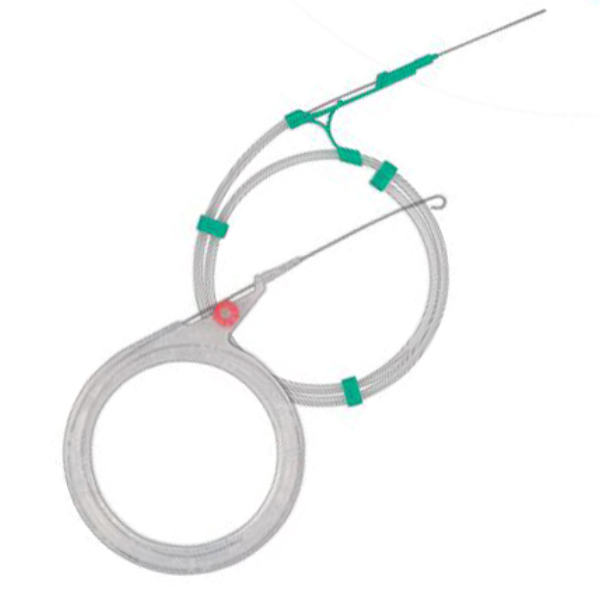
Nitinol Guidewires:
Nitinol, an alloy of nickel and titanium, is renowned for its unique properties, including excellent flexibility and the ability to return to its original shape after bending. ST Stone’s nitinol guidewires offer superior torqueability, making them ideal for procedures that require navigating through tight or complex anatomical structures. The combination of elasticity and flexibility ensures that these guidewires maintain its shape during use, providing the needed stability and control.
Key Features of Nitinol Guidewires:
- High flexibility and elasticity, ensuring stable navigation through complex pathways
- Excellent radiopacity for better visualization under X-ray
- Available with straight or angled tips for different procedural needs
- Provides exceptional torqueability, ensuring controlled and precise catheter placement
PTFE Coated Guidewires
PTFE (Polytetrafluoroethylene) is a high-performance polymer commonly used for coating guidewires. ST Stone Medical Device manufactures both pre-coated and post-coated PTFE guidewires to enhance performance and reduce surface friction. The PTFE coating is designed to improve the lubricity of the guidewire, making it easier to insert and advance through vessels.
There are two main types of PTFE coated guidewires: pre-coated and post-coated. Pre-coated guidewires have the PTFE coating applied during the manufacturing process, while post-coated guidewires receive the coating after the wire has been formed. Both types offer smooth insertion, resistance to damage and increased durability.
Key Features of PTFE Coated Guidewires:
- Excellent lubricity, reducing friction and allowing smooth entry and withdrawal
- Available in various sizes and lengths, catering to different medical applications
- Smooth tip design for easy catheter insertion
- Enhanced safety, reducing the risk of damage to the vascular walls
- Available in hydrophilic and non-hydrophilic versions
Hydrophilic Coated Guidewires
Hydrophilic Guidewires are coated with a layer of material that becomes lubricated upon contact with water. This coating provides a slick surface, making them ideal for use in wet environments, such as when navigating through blood vessels. The lubricity of hydrophilic guidewires is enhanced when exposed to moisture, making them smoother and easier to navigate, especially in challenging or tortuous anatomy.
ST Stone Medical Device offers hydrophilic coated guidewires that combine the flexibility of nitinol or stainless steel with the ultra-slick surface of the hydrophilic coating. This combination enhances trackability and maneuverability, providing the flexibility needed to perform precise procedures.
Key Features of Hydrophilic Guidewires:
- Ultra-slick surface for easy advancement and smooth tracking
- Enhanced flexibility and torqueability for complex procedures
- Available in a range of sizes, including flexible and floppy tips
- Excellent radiopacity for clear visualization during X-ray imaging
- Hydrophilic coating ensures ease of use in wet environments
Zebra Guidewires: A Unique Innovation
Zebra Guidewires are a specialized category of guidewires designed with a unique tungsten-polyurethane coating on the distal 60mm of the wire. This coating reduces surface friction, enhancing the wire’s ability to advance smoothly through the vascular system. The “zebra” pattern, created by the coating, provides visual cues that improve the guidewire’s visibility under X-ray imaging, assisting in precise navigation.
ST Stone’s zebra guidewires are engineered to reduce the risk of kinking, improve maneuverability and provide excellent control during procedures. These guidewires are particularly useful in situations where precise, controlled entry is required.
Key Features of Zebra Guidewires:
- Tungsten-polyurethane coating on the distal portion to reduce friction
- Enhanced X-ray visibility for improved navigation
- Smooth entry and advancement for ease of use
- Kink resistance, making them ideal for tortuous paths
- Available in various lengths and sizes, tailored to specific medical needs

Conclusion
ST Stone Medical Device stands at the forefront of guidewire manufacturing, delivering products designed with precision, flexibility and safety in mind. Their diverse range of guidewires – spanning from stainless steel and nitinol to PTFE coated, hydrophilic and zebra guidewires – offers the flexibility needed for various medical applications. Whether you require a guidewire for angioplasty, catheter insertion or stent placement, ST Stone provides solutions tailored to ensure smooth, efficient and safe procedures.
The innovative features of these guidewires, including kink resistance, radiopacity and smooth tip designs, help healthcare professionals navigate challenging anatomical structures with confidence. By leveraging cutting-edge materials and coatings, ST Stone Medical Device continues to set the standard in guidewire manufacturing, meeting the rigorous demands of the medical community and supporting the success of critical procedures.