
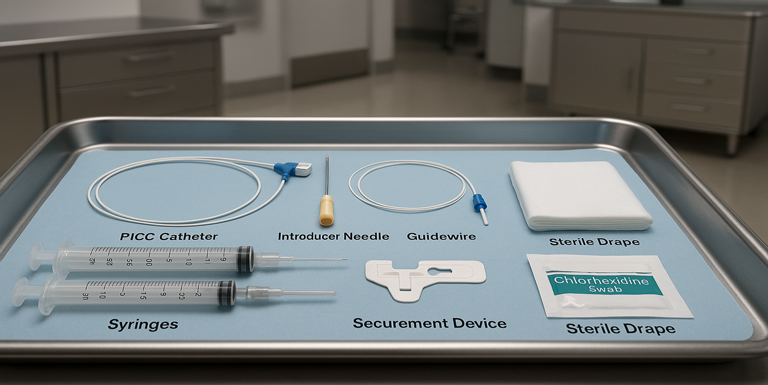
In the clinical landscape, managing long-term venous access for patients undergoing intensive treatments is a significant challenge. Whether it’s for chemotherapy, prolonged antibiotic administration or other critical care therapies, peripherally inserted central catheters (PICC) are an invaluable tool. These devices offer a reliable, less invasive alternative to traditional central venous catheters, allowing for safer long-term access while minimizing complications. The PICC kit plays a crucial role in this process, offering a streamlined approach to insertion, management and maintenance of the catheter.
PICC lines are primarily used for central venous access, where precise catheter placement ensures that medications or fluids can be delivered directly into the central circulation. This article explores the utility of the PICC kit, the essential components included and the clinical benefits associated with its use.
The PICC line is widely recognized for its clinical utility in managing patients who require extended intravenous therapy. Unlike traditional intravenous (IV) catheters, which are typically inserted into peripheral veins, a PICC is inserted into a peripheral vein and advanced toward the central veins, usually terminating near the superior vena cava. This unique design allows it to be used for extended periods without the risks associated with long-term central venous catheters (CVCs), such as infections or thrombosis.
The PICC catheter provides a reliable solution for administering hyperosmolar solutions, chemotherapy agents, antibiotics and other medications that may cause irritation or damage to peripheral veins. This versatility makes it an ideal choice for patients who require repeated access to the venous system over an extended period. Additionally, PICC insertion is less invasive compared to traditional CVC placement, making it a preferred option for patients requiring long-term care, such as those with cancer or chronic infections.
For healthcare facilities, offering a reliable and efficient PICC-Peripherally Inserted Central Catheter Kit ensures that healthcare providers have the necessary tools to perform the procedure with minimal risk to the patient.

The PICC catheter provides a reliable solution for administering hyperosmolar solutions, chemotherapy agents, antibiotics and other medications that may cause irritation or damage to peripheral veins. This versatility makes it an ideal choice for patients who require repeated access to the venous system over an extended period. Additionally, PICC insertion is less invasive compared to traditional CVC placement, making it a preferred option for patients requiring long-term care, such as those with cancer or chronic infections.
For healthcare facilities, offering a reliable and efficient PICC-Peripherally Inserted Central Catheter Kit ensures that healthcare providers have the necessary tools to perform the procedure with minimal risk to the patient.

The PICC line is widely recognized for its clinical utility in managing patients who require extended intravenous therapy. Unlike traditional intravenous (IV) catheters, which are typically inserted into peripheral veins, a PICC is inserted into a peripheral vein and advanced toward the central veins, usually terminating near the superior vena cava. This unique design allows it to be used for extended periods without the risks associated with long-term central venous catheters (CVCs), such as infections or thrombosis.
The PICC Kit contains all the essential components required for the insertion and maintenance of a peripherally inserted central catheter. Each component is designed to support safe and effective catheterization, improving the overall efficiency of the procedure. The key elements typically found in a PICC line kit include:
These components work together to provide a safe and efficient PICC insertion process, ensuring that the procedure is completed with minimal discomfort for the patient and optimal outcomes.
PICC catheters are generally indicated for patients who require long-term venous access, often for durations exceeding 30 days. This includes those undergoing treatments such as:
Additionally, PICC catheters are used for patients with conditions that make other types of venous access difficult, such as those with injuries or burns to the neck and chest area or patients undergoing radiotherapy. PICC-Peripherally Inserted Central Catheter Kits are designed to provide all the necessary tools for these procedures, ensuring that healthcare professionals can address a broad range of clinical needs effectively.
The PICC line offers several advantages over traditional venous access devices, particularly for patients requiring long-term intravenous therapy:

The insertion of a PICC catheter typically involves a sterile procedure performed by a trained clinician. The catheter is inserted into a peripheral vein, often in the arm and threaded through the vein until it reaches the central venous system, near the superior vena cava. The insertion process may be done using a percutaneous technique, in which the catheter is introduced through the skin with the help of an introducer needle.
While PICC insertion is a relatively simple procedure, it can come with challenges, such as improper placement or catheter-related thrombosis. Using a PICC kit that includes the necessary tools for proper insertion and securing of the catheter can help mitigate these risks. Accurate placement is critical to ensure that the catheter functions properly and remains in place for the duration of the therapy.
As the demand for long-term venous access grows, PICC lines continue to play an essential role in modern healthcare. With their ability to provide safe, reliable access for prolonged therapies, these catheters have become a cornerstone in the management of patients with complex treatment needs. The PICC Kit, complete with all necessary components for insertion and maintenance, simplifies the process and ensures that healthcare providers have the tools required to perform the procedure with minimal risk and maximum efficiency.
As medical technology advances, the future of PICC lines looks promising. Continued improvements in catheter materials, insertion techniques and infection prevention strategies will further enhance the safety and efficacy of this invaluable clinical tool. Whether used for chemotherapy, intravenous nutrition or long-term antibiotic therapy, PICC-Peripherally Inserted Central Catheter Kits will continue to be a vital part of patient care, supporting better outcomes and improved quality of life for patients across a range of clinical settings.
We are recognized as one of the leading manufacturers, exporters, and suppliers of a diverse range of high-quality medical devices in India. Our products, including Interventional Cardiology, Nephrology, Anaesthesia, General Consumables, and Critical Care Accessories, are designed to meet the highest standards of excellence, ensuring reliable performance and patient care.
A – 8, Kuraopokpi industrial Estate,
Thoubal (kakching) Imphal,
Manipur – 795001, India.