
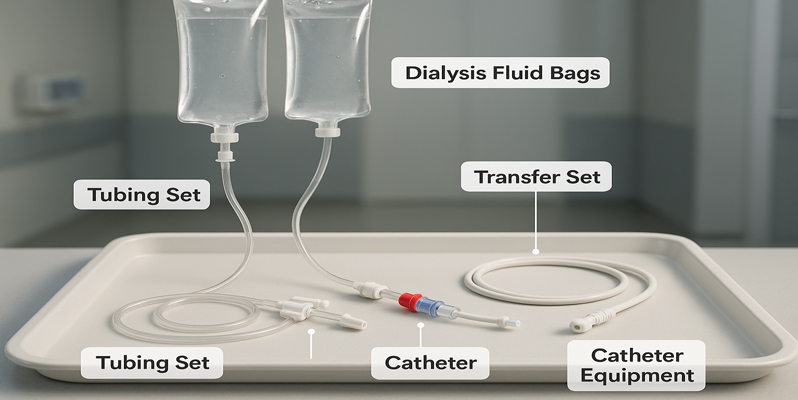
Peritoneal dialysis (PD) continues to serve as a vital renal replacement therapy for patients, offering autonomy and consistent clearance for those unsuitable for hemodialysis. At the core of PD success lies the effectiveness and reliability of the peritoneal dialysis catheter – a medical-grade conduit enabling the infusion and drainage of dialysate within the peritoneal cavity. For medical distributors, hospital procurement teams and OEM partners, a thorough understanding of catheter designs, materials and systems is critical to supporting both acute and chronic patient needs.
This article provides a focused, professional overview of peritoneal dialysis catheter systems, encompassing standard Tenckhoff designs, swan neck peritoneal catheters, peritoneal coil catheters and associated accessories such as the peritoneal dialysis transfer set, catheter kits and packages. It discusses the practical differences and benefits of each configuration to guide evidence-informed decisions.
The Tenckhoff peritoneal dialysis catheter remains a foundational component in PD therapy. This straight catheter system is widely recognized for its durability, low complication rates and consistent clinical performance. It comprises a soft silicone body embedded with polyester (Dacron) cuffs that anchor the catheter within subcutaneous tissue, forming a barrier against infection.
Tenckhoff catheters are available in multiple lengths, diameters and cuff placements to fit varied patient anatomies. Notably, standard models like PCS-30-1P (14.7Fr, 30cm, single cuff) and PCS-41-1P (14.7Fr, 41cm, single cuff) exemplify the precision engineering necessary for tailored therapy. With such models, clinicians may minimize trauma during insertion and optimize placement within the pelvic region.
The peritoneal dialysis catheter kit typically includes a matched transfer set and optional insertion accessories to support sterile implantation. These kits may be tailored for either continuous ambulatory peritoneal dialysis (CAPD) or automated peritoneal dialysis (APD), offering the flexibility that modern PD programs demand.

Straight peritoneal catheters follow the Tenckhoff form factor but are available in a variety of configurations, specifically designed for compatibility with patient-specific requirements such as age, body size or comorbidities. From the perspective of manufacturers and suppliers, the ability to provide multiple lengths and cuff placements is essential to serving nephrology clinics and surgical units.
Key models include:
These variations ensure that catheter performance aligns with catheter placement technique – be it percutaneous, surgical or laparoscopic. For example, shorter catheters may be preferred in pediatric patients or those with low abdominal girth, while longer catheters provide greater stability for taller or larger-framed individuals. Importantly, the double-cuff configurations, such as those in PCS-30-2P and PCS-32-2PX, enhance resistance to infection and tunnel migration.
The swan neck peritoneal catheter introduces a specialized curvature in the subcutaneous portion of the device, re-routing the exit site downward. This anatomical design aligns with the abdominal wall and mitigates mechanical complications such as migration and kinking, while promoting better drainage efficiency and reducing the risk of exit-site infections.
Key swan neck variants include:
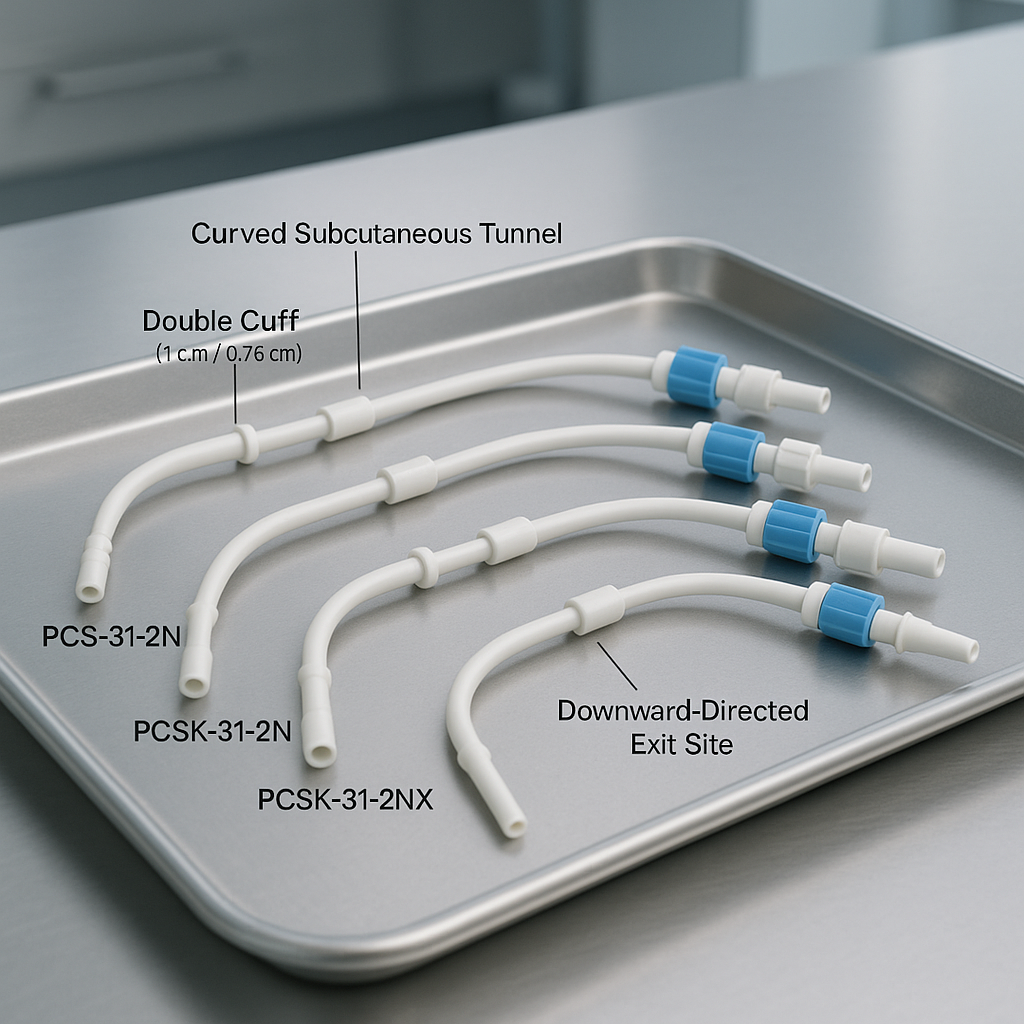
These catheters are engineered for patients with high BMI, increased intra-abdominal pressure or a history of catheter displacement. For institutional buyers and dialysis providers, swan neck catheters provide an excellent option for high-risk patient populations, offering superior mechanical stability and infection prevention.
The curved tunnel of the swan neck variant also simplifies securing the catheter against the abdominal wall, improving long-term viability and patient satisfaction.
Peritoneal coil catheters are designed with a coiled intraperitoneal tip, which provides internal anchoring and reduces the likelihood of migration or omental wrapping. The coiled structure offers distinct advantages in maintaining intraperitoneal position, especially when used in combination with an extended double-cuff structure.
The coiled tip acts like a spring, resisting displacement while maintaining consistent fluid flow during both fill and drain cycles. Clinicians report that these catheters may result in fewer occlusions and reduced need for repositioning. They are well-suited for long-term PD programs, particularly in patients with prior catheter complications or anatomical challenges.
Though specific coiled models are less frequently deployed compared to straight or swan neck variants, their clinical benefits make them a valued part of a comprehensive catheter portfolio.
Integral to PD catheter systems are the peritoneal dialysis transfer sets, which facilitate safe dialysate exchanges while minimizing contamination risk. These transfer sets often include Y-sets, connectors and tubing components compatible with both CAPD and APD systems.
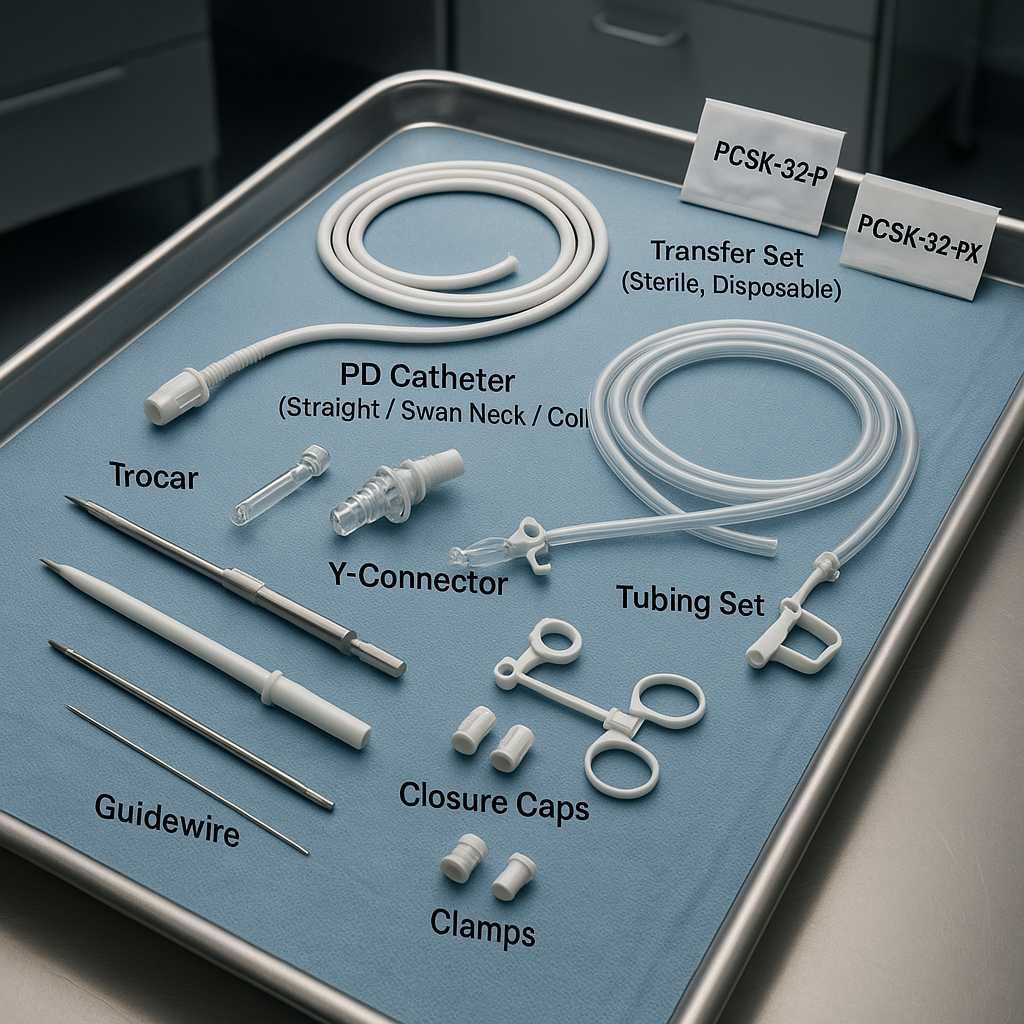
Incorporating the transfer set into a peritoneal dialysis catheter kit simplifies inventory management for clinical procurement teams. A standard kit may contain:
Kits like PCSK-30-2P or PCSK-32-2PX reflect this integrated approach, supporting efficient deployment in both outpatient and surgical settings. Standardization across kits promotes consistency in care and training, while reducing procedural errors and waste.

ST Stone Medical Device, being a leader in peritoneal dialysis catheter manufacturer plays a critical role in ensuring product consistency, sterility and clinical performance. Modern PD catheters are typically made from biocompatible medical-grade silicone, with high-precision molding to ensure lumen integrity and flow efficiency.
In the landscape of renal replacement therapy, peritoneal dialysis catheter systems remain a cornerstone for enabling effective and autonomous patient care. From the time-tested Tenckhoff catheter to the ergonomically advanced swan neck and internally stabilizing coil catheters, each variant fulfills distinct clinical needs. With a wide range of available lengths, diameters and cuff configurations, ST Stone Medical Device, being a leader in suppliers and manufacturers must align product offerings with clinical protocols and patient demographics.
ST Stone Medical Device, as a leading Peritoneal Dialysis Catheter distributor – can enhance value by offering integrated solutions, ensuring compatibility, ease of use and infection prevention. As technology and patient needs continue to evolve, maintaining a comprehensive and adaptable product portfolio remains essential.
We are recognized as one of the leading manufacturers, exporters, and suppliers of a diverse range of high-quality medical devices in India. Our products, including Interventional Cardiology, Nephrology, Anaesthesia, General Consumables, and Critical Care Accessories, are designed to meet the highest standards of excellence, ensuring reliable performance and patient care.
A – 8, Kuraopokpi industrial Estate,
Thoubal (kakching) Imphal,
Manipur – 795001, India.