Read Our Article
Why PTFE Coated Guidewires Are Essential for Angiography Procedures?
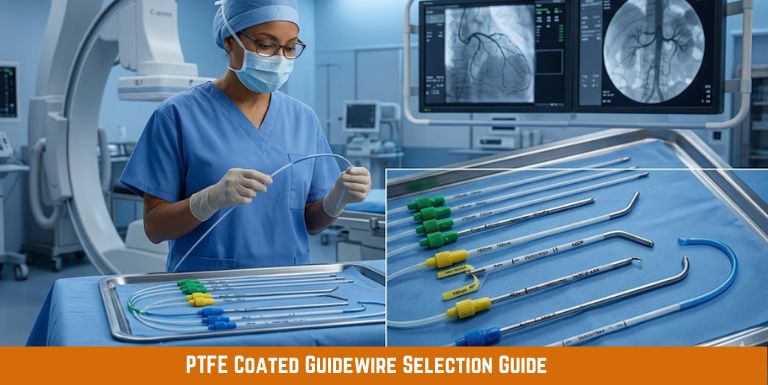
Selecting the correct PTFE coated guidewire is one of the most critical decisions in interventional procedures. Whether used in cardiovascular, urological or gastrointestinal applications, the right guidewire determines how smoothly a procedure progresses. With so many options available from various manufacturers, understanding the key selection criteria – length, shape and flexibility – helps clinicians and procurement professionals make informed choices. This guide breaks down each factor with precision, so you know exactly what to evaluate before sourcing from a PTFE coated guidewire supplier.
 Email Us!
Length is the first specification to evaluate when selecting a PTFE guidewire. Standard lengths typically range from 45 cm to 260 cm and the appropriate choice depends on the procedural pathway, the type of catheter being used and the exchange requirements.
Short guidewires (45–80 cm) are commonly used for direct-access procedures where minimal advancement is needed. Medium-length wires (150–180 cm) are the most widely used across interventional cardiology and radiology, offering enough working length without being cumbersome. Long exchange wires (260–300 cm) are reserved for catheter exchanges or complex navigation through tortuous anatomical paths.
When sourcing from a PTFE coated guidewire manufacturer, always verify that the wire length is consistent across the entire batch. Even minor deviations in manufactured length can affect procedural timing. Leading manufacturers provide standardised length tolerances, typically within ±1 cm, which matters significantly in high-volume clinical settings.
Read Our Article
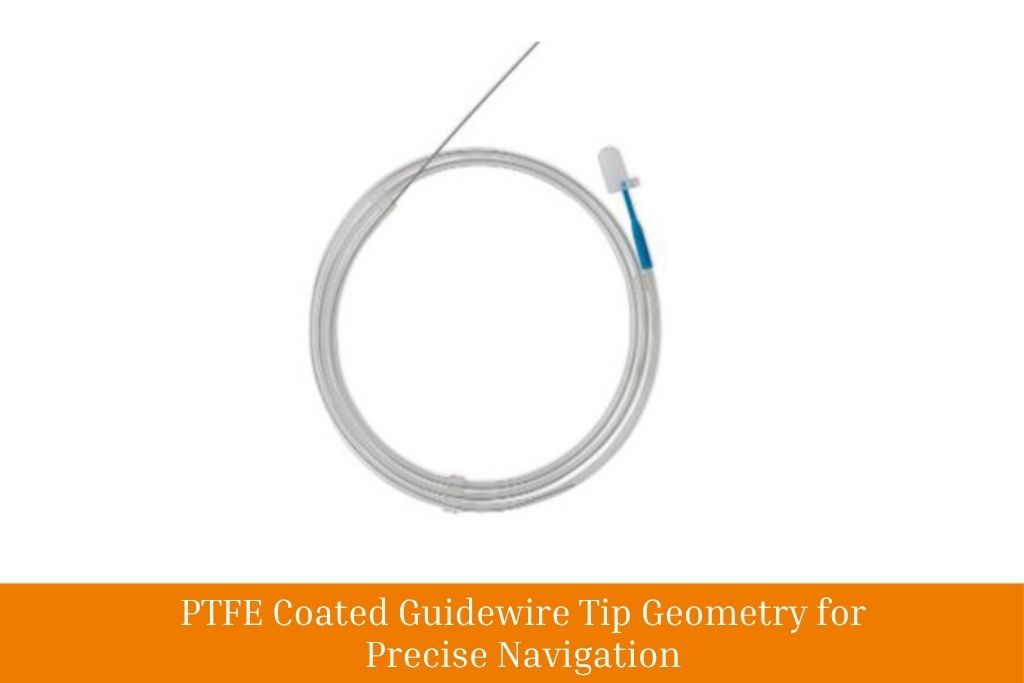
Why PTFE Coated Guidewires Are Essential for Angiography Procedures?Tip shape is one of the most defining characteristics of a PTFE coated guidewire. The geometry of the distal tip determines how the wire navigates through vessels, ducts or lumens and choosing the wrong shape can lead to vessel trauma or failed cannulation.
The three most common tip configurations are:
Straight tip – Ideal for straightforward, wide-lumen access where minimal steering is required. It offers consistent forward progression and is the most commonly stocked option.
J-tip (curved tip) – The J-shape is engineered to reduce the risk of vessel perforation. It is frequently recommended for aortic or venous access, where the curved geometry allows the wire to deflect away from vessel walls rather than puncture them.
Angled tip – Used when directional steering is necessary to enter branching vessels or navigate tight anatomical angles. Typically paired with a torque device.
A reliable pre-coated PTFE guidewire manufacturer will offer all three configurations with tight dimensional consistency across tip radius, deflection angle and distal flexibility gradient. When procuring in bulk, always request dimensional drawings or test certificates for tip geometry to ensure procedural suitability.
Our Other Product
Stainless Steel & Nitinol GuidewireFlexibility in a PTFE coated guide wire is not a single property – it is a zonal characteristic distributed across the proximal shaft, transition zone and distal tip. Each zone serves a different mechanical role during insertion, navigation and device tracking.
Proximal shaft stiffness provides the pushability needed to advance the wire through resistance. A stiffer proximal section ensures that force applied at the handle translates efficiently to forward motion at the tip.
Transition zone flexibility prevents kinking when the wire bends around anatomical curves. A well-designed transition zone allows gradual bending without compromising torque transmission.
Distal tip softness minimises the risk of vessel or tissue trauma. The tip must be compliant enough to deflect rather than puncture, while still offering enough stiffness to be tracked accurately.
PTFE coating plays a significant role in overall flexibility performance. The coating reduces surface friction, which lowers resistance during navigation, but the thickness and uniformity of the PTFE layer directly affect how the wire behaves under bending stress. Post coated PTFE guidewires are processed after core wire forming, which can introduce minor coating variations in highly curved regions. Pre-coated PTFE guidewires, on the other hand, apply the coating to the wire material earlier in the manufacturing process, often resulting in better coating adhesion in complex bending zones.
When evaluating flexibility specifications, ask your PTFE coated guidewire supplier for documented stiffness measurements across all three zones. This data is essential for matching the wire to specific clinical applications.
The distinction between pre-coated and post-coated PTFE guidewires directly affects coating durability, lubricity consistency and long-term performance during procedures.
A pre-coated PTFE guidewire is manufactured by applying the PTFE material to the wire substrate before final shaping or forming. This process allows the coating to integrate more uniformly with the core, resulting in stronger adhesion and reduced risk of coating delamination during use. Pre-coated PTFE guidewire manufacturers typically engineer this approach for wires intended for complex or longer-duration procedures where coating integrity is critical.
A post coated PTFE guidewire involves applying the coating after the wire has been formed into its final shape. While this process offers manufacturing flexibility – particularly for custom tip shapes or complex geometries – it can sometimes result in thinner or less uniform coating at bending points.
From a procurement standpoint, the choice between pre and post-coated options should be driven by the end application. For standard, high-volume procedural use, a post coated PTFE guidewire manufacturer with validated coating processes can supply cost-effective solutions. For demanding interventional procedures or specialty medical devices, pre-coated options generally offer superior coating consistency.
Always request peel strength data, coating thickness measurements and sterilisation compatibility documentation from any pre-coated or post coated PTFE guidewire manufacturer before finalising supplier qualification.
Core material selection works in conjunction with coating type, tip shape and length to define overall guidewire performance. The two primary core materials are stainless steel and nitinol.
Stainless steel cores offer excellent torque response and pushability, making them suitable for procedures requiring precise directional control. They are stiffer by nature, which limits their use in highly tortuous anatomies but makes them ideal for straightforward, high-resistance passages.
Nitinol cores provide shape memory and superelastic properties, allowing the wire to recover its original shape after significant bending. This makes nitinol-cored PTFE guidewires the preferred choice for complex vascular anatomy, endoscopic retrograde cholangiopancreatography (ERCP) and ureteroscopic procedures where the wire must navigate multiple tight curves without losing responsiveness.
When discussing specifications with a PTFE coated guidewire supplier, confirm core material compatibility with the intended coating process. Not all PTFE coating methods adhere equally well to nitinol and stainless steel and your supplier should provide adhesion testing data specific to the core material used.
Our Other Product
PTCA GuidewireChoosing the right manufacturer or supplier is as important as selecting the right wire specification. When evaluating a PTFE coated guidewire manufacturer, the following criteria should guide the qualification process:
Regulatory compliance is non-negotiable. The manufacturer should hold ISO 13485 certification and, depending on your market, CE marking or FDA registration. These certifications confirm that quality management systems meet medical device standards.
Customisation capability matters when off-the-shelf options do not meet procedural requirements. A capable supplier should offer custom lengths, tip configurations, core materials and coating types – with validated processes for each combination.
Batch consistency and traceability are critical for large-volume procurement. The manufacturer should provide full traceability documentation for each production batch, including coating thickness reports, dimensional inspections and biocompatibility test records.
Lead time and scalability should also be assessed. A supplier that cannot meet production demands under increased volume will create procurement risk. Evaluate their manufacturing capacity, minimum order quantities and turnaround benchmarks before committing to a long-term contract.
 Call Now!
Selecting the right PTFE coated guidewire requires evaluating length, tip shape, flexibility zones, coating method and core material as interconnected factors – not isolated specifications. Whether you are comparing pre-coated or post-coated options or qualifying a new PTFE coated guidewire manufacturer, the decision should always be backed by documented performance data and verified manufacturing standards. A well-chosen guidewire, sourced from a credible supplier, contributes directly to procedural efficiency, patient safety and device reliability across clinical settings.
We are recognized as one of the leading manufacturers, exporters, and suppliers of a diverse range of high-quality medical devices in India. Our products, including Interventional Cardiology, Nephrology, Anaesthesia, General Consumables, and Critical Care Accessories, are designed to meet the highest standards of excellence, ensuring reliable performance and patient care.
A – 8, Kuraopokpi industrial Estate,
Thoubal (kakching) Imphal,
Manipur – 795001, India.