Read Our Article
Short-Term Hemodialysis Catheter Kits: Essential Tools for Efficient Dialysis Treatment
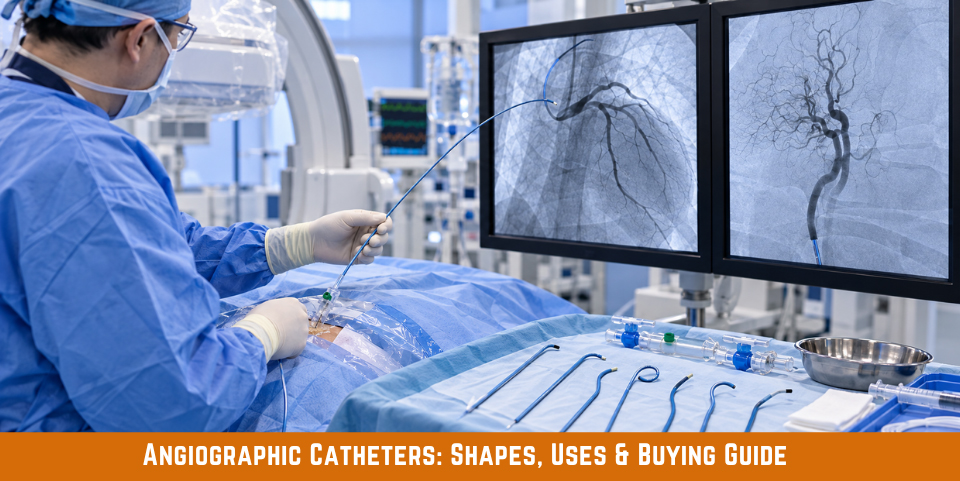
An angiographic or diagnostic catheter is a hollow tube, inserted through an introducer sheath and advanced through the vascular system, whose purpose is to deliver radiopaque contrast media to a specific site so that a physician can visualize the surrounding blood vessels under fluoroscopy. Beyond simple contrast delivery, these catheters are also used to help guide a wire or another catheter to a target site, and to measure pressure at specific points within the vascular system. The fundamental design is simple, a tube with a center lumen for fluid flow, but the shape of the distal tip is what determines which vessel or chamber the catheter can reach and how easily it gets there.
Because coronary, peripheral, and cerebral angiography each involve reaching very different anatomical targets, a single catheter shape cannot serve every case. This is why manufacturers produce angiographic catheters in dozens of preformed shapes, and why hospitals sourcing these devices need to understand the difference between the major categories rather than assuming one general purpose catheter will cover most procedures.
 Drop Us an Email!
The Judkins left and Judkins right catheters, developed by Melvin Judkins for femoral access coronary angiography, remain the most widely used diagnostic catheters for imaging the coronary arteries. The Judkins left catheter is favored because its preformed curve requires very little manipulation to engage the left main coronary artery in most patients, and the Judkins right catheter serves the equivalent role for the right coronary artery. Their widespread familiarity among interventional teams is itself an advantage, since staff across most cath labs are already trained on their handling characteristics, reducing the learning curve compared with less common catheter shapes.
Other coronary shapes, including the Amplatz left and various multipurpose catheters, are kept in stock for the patients whose coronary ostium anatomy does not respond well to the standard Judkins curve, which happens often enough that a cath lab relying on Judkins catheters alone will periodically find itself without the right tool for the case in front of it.
The pigtail catheter, also developed by Judkins, has a distinct design compared with the selective coronary shapes. It consists of a relatively straight body with multiple side holes along its terminal segment, ending in a tightly coiled, pigtail shaped tip. This shape serves two purposes. The multiple side holes allow contrast to disperse in a wide pattern rather than as a single high pressure jet, which is important in larger chambers such as the left ventricle or the aorta, and the coiled tip reduces the risk of the catheter tip whipping against the vessel or chamber wall during a rapid contrast injection. Pigtail catheters are the standard choice for ventriculography and for non selective aortography, such as imaging the distal descending aorta above the iliac bifurcation before a lower extremity angiogram.
Diagnostic catheters are generally available in 4, 5, and 6 French sizes, with smaller sizes increasingly favored as radial access has become more common, since a narrower catheter reduces trauma to the smaller radial artery. Most catheters are constructed with a braided shaft, meaning a layer of woven wire or fiber is embedded within the catheter wall. This braiding is what gives the catheter its torque control, allowing rotation applied at the proximal end outside the body to translate into a corresponding rotation at the distal tip, which is essential for steering the catheter into the correct vessel ostium without excessive manipulation.
Catheters intended for radial access procedures sometimes include specialized shapes designed to reach both the right and left coronary arteries with a single catheter, reducing the number of catheter exchanges needed and shortening both procedure time and fluoroscopy exposure. This single catheter approach has become more common as radial access programs have grown, since minimizing exchanges matters more when working through a smaller, more sensitive access vessel.
Many diagnostic catheters are available with a hydrophilic coating along part or all of the shaft, which reduces friction as the catheter advances through the vascular system, particularly helpful in older or more tortuous vessels. Uncoated catheters, while requiring slightly more manipulation force, are often preferred for their more direct tactile feedback, which some operators rely on to sense when the catheter tip has engaged the target vessel. Hospitals stocking both coated and uncoated options give their interventional teams the flexibility to choose based on patient anatomy rather than being limited to whichever type happens to be in inventory.
Our Other Product
Pressure Monitoring Kit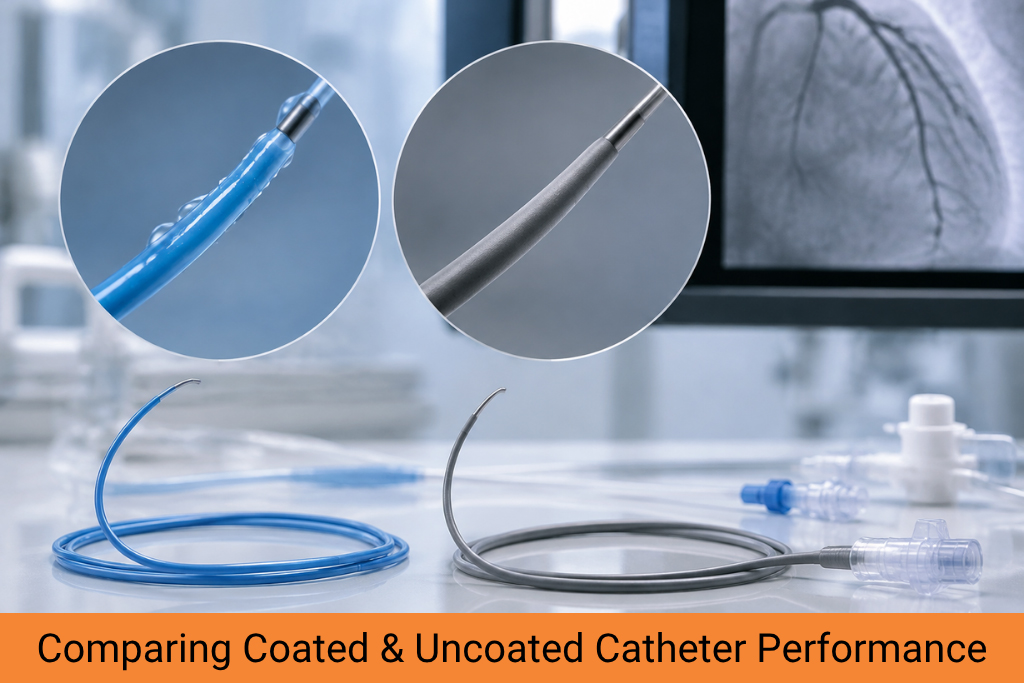
Even with a wide range of preformed shapes available, choosing the right catheter for a given patient is not a purely mechanical decision. Aortic root size, the angle at which the coronary arteries originate, and prior cardiac surgery can all change how a standard shape behaves once inside the body. An interventional team that regularly encounters difficult anatomy benefits from having access to a broader shape library, including less commonly stocked options such as the Amplatz and multipurpose families, so that a difficult case does not become a repeated trial and error exercise with the same one or two catheters already in the tray.
This is one of the practical reasons hospitals should periodically review their diagnostic catheter inventory against the case mix they are actually seeing, rather than relying on a purchasing list that was set years earlier and never revisited. A shift toward more complex interventional cases, or a growing radial access program, often calls for a corresponding shift in which catheter shapes and sizes are kept on hand.
Procurement teams sourcing angiographic and diagnostic catheters should first confirm the supplier’s catalog covers the core shapes any general cath lab needs, Judkins left, Judkins right, and pigtail at minimum, before considering more specialized cerebral, visceral, or peripheral shapes. Second, French size range and available shaft lengths should match the access routes the hospital actually uses, since a facility running both femoral and radial programs needs a broader size and length selection than one committed to a single approach. Third, since these catheters carry contrast media at controlled pressures, documentation of pressure limits and guidewire compatibility should be clear and verified against applicable medical device standards, given that an underrated catheter used at the wrong pressure risks rupture during injection.
St Stone Medical Devices manufactures angiographic and diagnostic catheters across the major coronary and peripheral shapes, with both coated and uncoated options and a range of French sizes, supplying hospitals and distributors who need dependable diagnostic catheters for consistent procedural volume across coronary, peripheral, and general angiography work.
Distributors who supply several hospitals across a region often deal with a wide spread of preferences, since one cath lab may standardize on Judkins shapes for nearly every case while another maintains a broader working set including Amplatz and multipurpose catheters. Rather than stocking a narrow product line and turning away requests that fall outside it, distributors are better served by partnering with a manufacturer who produces the full spread of standard shapes at consistent quality, allowing the distributor to meet each hospital’s actual preferences without needing multiple supplier relationships for what is fundamentally the same category of device.
Beyond the coronary specific shapes discussed so far, angiographic catheters used for cerebral, visceral, and peripheral studies draw from an even wider shape library, since the vascular targets in these regions vary considerably in angle and depth from the aortic access point. Cerebral catheters need enough length and torque control to navigate from a femoral or radial puncture all the way up through the aortic arch and into the carotid or vertebral circulation, while visceral catheters are shaped to selectively engage vessels such as the celiac trunk, superior mesenteric artery, or renal arteries from within the abdominal aorta. Hospitals that perform interventional radiology procedures alongside cardiac catheterization need a broader shape inventory than a cath lab focused purely on coronary work, and procurement teams should map their catalog against the actual range of procedures performed across departments rather than assuming a cardiology focused shape set covers every use case in the hospital.
Diagnostic catheters are rated for a maximum pressure limit that varies by French size and wall construction, and this rating matters directly when a power injector is used to deliver a rapid, high volume contrast bolus, as is common in aortography or pulmonary angiography. Using a catheter beyond its rated pressure limit risks catheter rupture during injection, which can occur inside the patient with serious consequences. Procurement teams should confirm that pressure ratings are clearly documented for every catheter in their inventory and that staff are trained to match injector settings to the specific catheter in use, rather than applying a single default injection protocol across all catheter types stocked in the department.
The angiographic catheter is often treated as a routine, interchangeable disposable, yet its shape, size, and construction directly determine how easily a physician can reach and image the target vessel. A cath lab stocked with only a narrow range of shapes will inevitably encounter cases where the standard catheter simply does not fit the patient’s anatomy well, adding time and risk to an otherwise straightforward diagnostic procedure. Hospitals and distributors benefit from working with a manufacturer that supplies a genuine range of shapes, sizes, and coating options, and St Stone Medical Devices continues to support cath labs with angiographic and diagnostic catheters built to meet that range of clinical need.
We are recognized as one of the leading manufacturers, exporters, and suppliers of a diverse range of high-quality medical devices in India. Our products, including Interventional Cardiology, Nephrology, Anaesthesia, General Consumables, and Critical Care Accessories, are designed to meet the highest standards of excellence, ensuring reliable performance and patient care.
A – 8, Kuraopokpi industrial Estate,
Thoubal (kakching) Imphal,
Manipur – 795001, India.