Read Our Article
Choosing the Right Skin Stapler Manufacturer for Your Surgical Practice
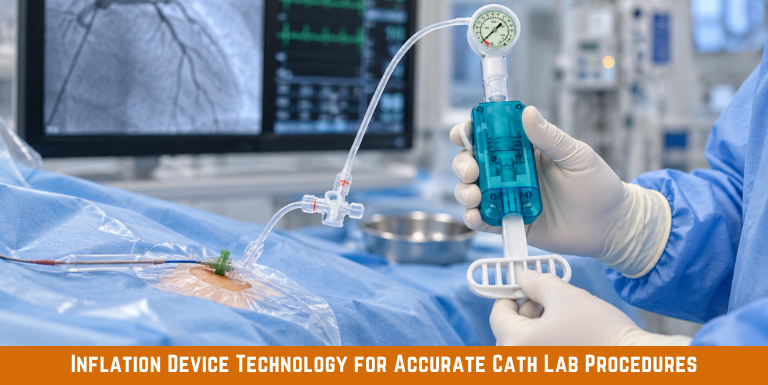
An inflation device is the handheld pressure tool that fills a balloon catheter with fluid during angioplasty, allowing the operator to inflate the balloon to a specific, controlled pressure at the site of a coronary or peripheral lesion. It is essentially a specialized high pressure syringe fitted with an analog or digital pressure gauge, a plunger mechanism, and a connection port that links to the balloon catheter through an extension tube. Once the balloon is positioned across the target lesion, the operator uses the inflation device to bring the balloon up to the pressure specified for that particular catheter and lesion, hold it there for the required duration, and then create a vacuum to fully deflate the balloon before withdrawal.
This sounds like a simple mechanical task, but the margin for error is small. Underinflating a balloon can leave a lesion inadequately treated, while overinflating beyond the catheter’s rated burst pressure risks rupturing the balloon inside the vessel. The inflation device is what stands between the operator’s hand and that outcome, which is why its accuracy and reliability matter as much as any other consumable used during the procedure.
Inflation devices are generally built to reach pressures well beyond what a standard syringe can safely generate, often up to around 30 bar, since some balloon catheters, particularly non compliant balloons used for post dilation or heavily calcified lesions, require considerably higher pressures to achieve full expansion than a typical semi compliant balloon. A device with a limited pressure range restricts which catheters and lesion types a cath lab can treat without switching to a different tool mid procedure, so a general purpose inflation device rated for high pressure use gives the team more flexibility across varied case types.
The gauge itself needs to display pressure clearly and accurately, since the operator is reading it under time pressure while simultaneously managing the catheter position and patient monitoring. Devices with illuminated or back lit gauges have become more common in recent years, making the reading easier to see clearly under the dimmed lighting conditions typical of a cath lab during fluoroscopy.
 Call Us Now!
Most inflation devices operate in two stages. A rough, rapid adjustment is made by pushing the plunger inward directly by hand, quickly bringing the balloon close to its target pressure. From there, a threaded fine adjustment mechanism allows the operator to dial the pressure up or down in small, controlled increments until the exact target reading is reached. A locking mechanism, often controlled by a thumb button, engages the threaded plunger so the operator can maintain the balloon at a fixed pressure for the required inflation time without having to continuously apply manual force.
This locking feature is more than a convenience. Many angioplasty protocols call for holding balloon inflation at a specific pressure for a set number of seconds, and a device that cannot hold pressure reliably without constant manual effort makes it harder to maintain that consistency, particularly during longer inflations or staged dilations.
Gun type inflation devices, built with an ergonomic pistol grip handle, have become a common choice in cath labs handling high procedural volume, since the grip allows the operator to generate and hold pressure with less hand fatigue over a long procedure list compared with a straight syringe style device. The underlying mechanism, a high pressure syringe barrel connected to a gauge, is largely the same across both styles, so the choice between gun type and standard designs often comes down to operator comfort and hand size rather than a meaningful difference in pressure accuracy.
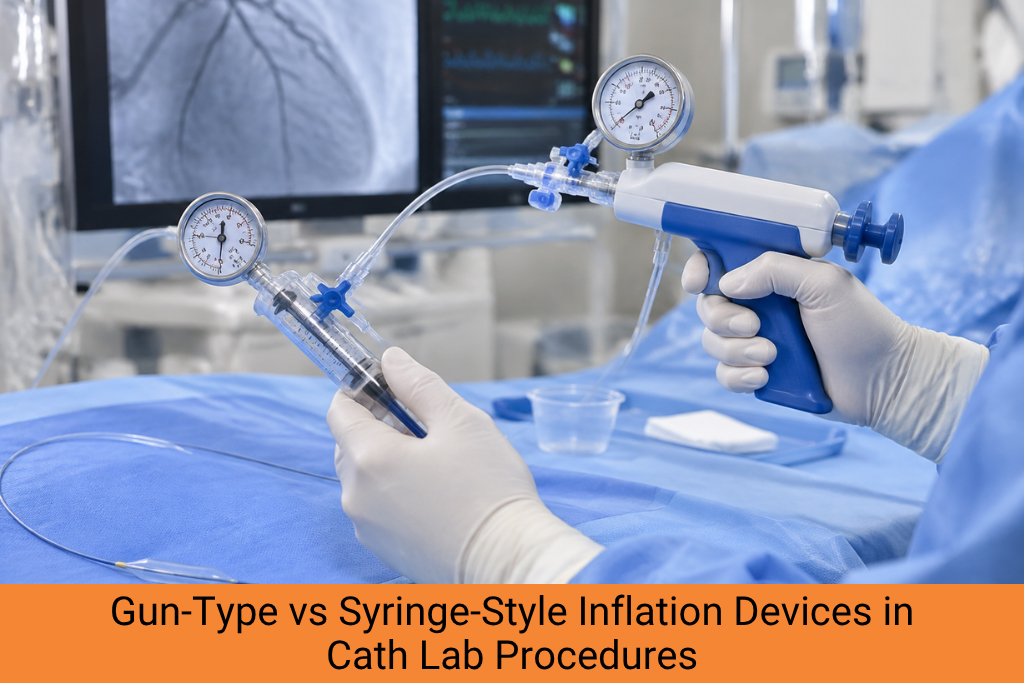
Most inflation devices include a three way stopcock at the connection point, allowing the operator to switch between drawing fluid into the syringe, delivering it to the balloon, and venting the line without disconnecting the device from the catheter. This matters during priming, the step where all air is purged from the system before the device is connected to the patient, since any air left in the line can compress under pressure and give a false, unreliable reading on the gauge rather than an accurate measure of the pressure actually reaching the balloon. Flexible high pressure extension tubing connects the device to the catheter hub, giving the operator working distance from the sterile field without sacrificing pressure transmission.
Even a well built inflation device can give a misleading reading if the system has not been properly primed before use. Any trapped air in the syringe barrel, extension tubing, or catheter lumen compresses under pressure, which means the gauge can show a target pressure has been reached while the balloon itself is still under inflated, since some of the applied force is being absorbed by compressing the trapped air rather than expanding the balloon. This is why most cath lab protocols call for flushing the entire system with fluid and expelling all visible air before the device is connected to the patient, and it is also why the three way stopcock design matters, since it lets the operator vent air without having to disconnect and reassemble the entire line.
Our Other Product
Double Lumen CatheterWhile analog dial gauges remain the most common display type on inflation devices, digital pressure readouts have become more widely available, offering a numeric display that some operators find easier to read precisely compared with interpreting a needle position on a dial. Digital devices typically rely on a battery powered pressure transducer, which introduces a dependency on battery reliability that analog devices do not have. Hospitals evaluating both types should weigh the readability benefits of a digital display against the operational simplicity of an analog gauge that has no power source to fail mid procedure.
Procurement teams sourcing inflation devices should first confirm the pressure range meets or exceeds the requirements of the highest pressure balloon catheters used in their cath lab, rather than assuming a standard mid range device will cover every case. Second, gauge accuracy should be verified against the manufacturer’s stated tolerance, since even a small reading error becomes clinically significant at higher pressures where the margin between adequate dilation and balloon rupture narrows. Third, since these are single use disposable devices in most modern cath labs, packaging integrity and sterilization documentation should be clear, and hospitals running high procedural volume should confirm the supplier can maintain consistent supply without gaps. Fourth, distributors supplying multiple cath labs should account for the mix of analog and digital preferences across their customer base rather than assuming every facility wants the same display type.
St Stone Medical Devices manufactures inflation devices, including gun type models with high pressure capability and clearly calibrated gauges, supplying hospitals and distributors who need dependable pressure control tools for balloon angioplasty and related interventional procedures.
Compliant and semi compliant balloons expand gradually as pressure increases, while non compliant balloons are engineered to hold a fixed diameter across a wide pressure range until they approach their rated burst pressure, at which point they expand very little right up until failure. This distinction matters for inflation device selection because non compliant balloons, often used for stent post dilation or for calcified lesions requiring high pressure to achieve full expansion, demand both a wider pressure range and finer control near the upper end of that range compared with what a compliant balloon typically requires. An inflation device with coarse pressure increments at the higher end of its scale makes it harder for the operator to stop precisely at the intended pressure with a non compliant balloon, increasing the risk of either under expansion or exceeding the rated burst pressure.
Interventional procedure documentation typically records the exact inflation pressure and duration used for each balloon deployment, information that becomes part of the patient’s permanent procedural record and can matter for future reference if the patient requires repeat intervention at the same site. This makes gauge accuracy not just a safety consideration in the moment but a data integrity consideration for the broader clinical record. Hospitals should periodically verify inflation device calibration against a known reference standard as part of routine biomedical equipment maintenance, treating these devices with the same rigor applied to other pressure sensitive medical equipment rather than assuming a disposable device requires no ongoing verification.
The inflation device rarely draws attention in discussions about cath lab consumables, yet it is the tool that translates a physician’s clinical decision about balloon pressure into a precise, controlled action inside the patient’s vessel. A device with a limited pressure range, an inaccurate gauge, or a locking mechanism that does not hold reliably introduces risk into a step of the procedure that should otherwise be straightforward. Hospitals and distributors benefit from treating inflation device selection with the same scrutiny applied to catheters and guidewires, and St Stone Medical Devices continues to supply cath labs with inflation devices built to meet that standard.
We are recognized as one of the leading manufacturers, exporters, and suppliers of a diverse range of high-quality medical devices in India. Our products, including Interventional Cardiology, Nephrology, Anaesthesia, General Consumables, and Critical Care Accessories, are designed to meet the highest standards of excellence, ensuring reliable performance and patient care.
A – 8, Kuraopokpi industrial Estate,
Thoubal (kakching) Imphal,
Manipur – 795001, India.