Read Our Article
Choosing the Right PTFE Coated Guidewire: What to Look for in Terms of Length, Shape and Flexibility
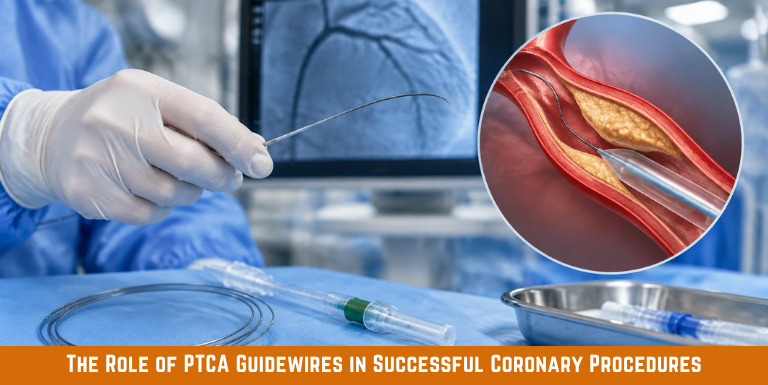
A percutaneous transluminal coronary angioplasty guidewire, commonly called a PTCA guidewire, is the thin steerable wire that leads every balloon catheter and stent delivery system through the coronary arteries during an angioplasty procedure. Once the guiding catheter is seated at the entrance of the target vessel, the interventional cardiologist advances the PTCA guidewire across the narrowed or blocked segment first, and only then does the balloon catheter or stent system track over it to reach the lesion. Without a reliable guidewire, none of the other tools in a cath lab can reach their destination safely.
For hospitals, distributors, and cath lab procurement teams, understanding what separates one PTCA guidewire from another is not a small technical detail. The right wire choice affects procedure time, first pass success, and patient safety, which is why hospitals and distributors evaluating suppliers such as St Stone Medical Devices look closely at core material, coating, tip load, and torque response before finalizing an order. A cath lab that stocks only a single generic wire often finds itself unprepared the moment a case turns out to be more complex than expected, and that gap in inventory planning can cost valuable procedure time.
Almost every PTCA guidewire on the market today is built around a 0.014 inch diameter core, a size that has become the practical standard for coronary work because it balances flexibility with enough column strength to push through tortuous vessels. The core itself is usually made from one of two materials. Stainless steel cores give the operator precise, direct torque response, meaning that a twist at the proximal end of the wire translates almost immediately into movement at the distal tip. Nitinol cores, by contrast, resist kinking far better than stainless steel and tolerate repeated bending without losing their shape, which is valuable in vessels with sharp turns, though the torque response is generally a step behind stainless steel.
Neither material is universally superior. The choice depends on the anatomy being treated and the operator’s preference, which is why many manufacturers, including St Stone Medical Devices, offer both core types across their guidewire range rather than standardizing on one. A hospital that performs a high volume of complex, tortuous cases may lean toward nitinol core wires as a baseline stock item, while a lab with a steadier mix of routine angioplasty cases may find stainless steel cores sufficient for most of its inventory.
 Email Us Today!
Tip load, usually measured in grams, describes how much force the distal tip of the guidewire can exert before it bends. This single specification is often the first thing an interventional cardiologist checks when selecting a wire for a specific case. A low tip load wire, generally under one gram, is considered a workhorse wire and is used in the majority of routine angioplasty procedures because it moves through the vessel with minimal risk of perforation. Higher tip load wires, sometimes exceeding three grams, are reserved for chronic total occlusions and heavily calcified lesions where extra penetrating force is needed to cross the blockage.
Why does a hospital need more than one tip load option in stock? Because a single cath lab may see anything from a straightforward single vessel disease case to a complex chronic total occlusion in the same week, and having only one type of PTCA guidewire on the shelf forces the team to either compromise on technique or delay the procedure while an alternative wire is sourced. Procurement teams that plan their inventory around at least three tip load tiers, a soft workhorse wire, a moderate support wire, and a stiffer penetrating wire, are generally better equipped to handle whatever anatomy walks through the door.
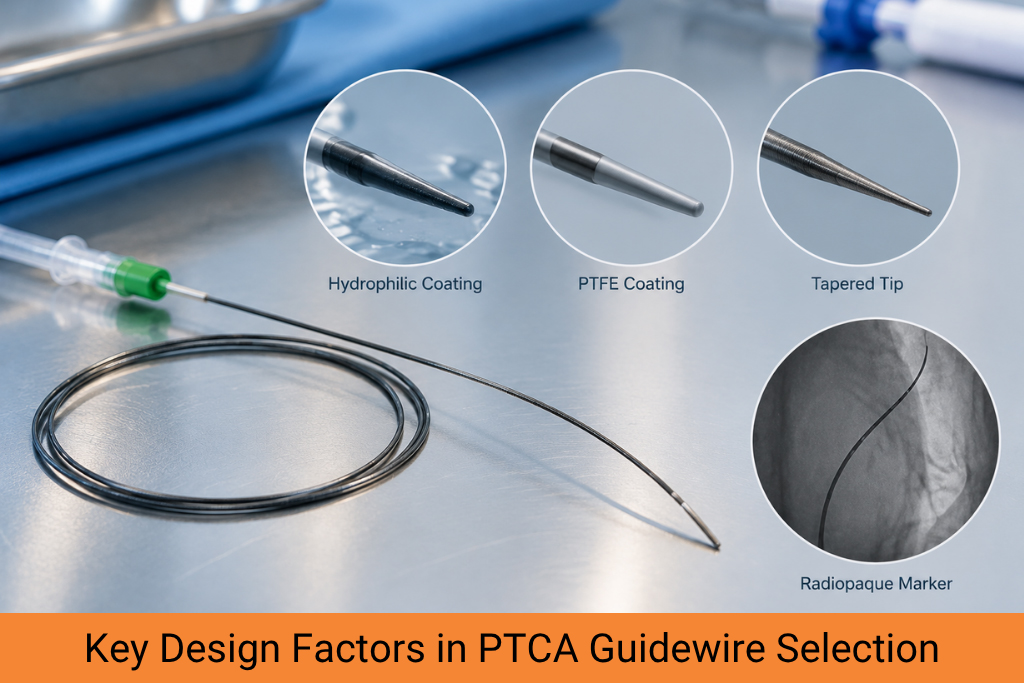
Beyond the core and tip load, the surface coating of a PTCA guidewire changes how it behaves inside the vessel. Hydrophilic coatings absorb fluid and become extremely slippery once wet, which helps the wire glide through tight, tortuous, or heavily narrowed segments with less friction. This comes with a tradeoff, since the same slipperiness that helps the wire advance can make it harder for the operator to feel resistance, slightly raising the risk of vessel wall injury if used without care. PTFE coated wires offer a more moderate reduction in friction and are often chosen for general use where extreme lubricity is not required.
Tip taper is another variable worth understanding. When the core wire is ground down gradually as it approaches the tip, the transition is smooth and the tip remains relatively soft, which is gentler on the vessel wall. A shorter, more abrupt taper produces a tip that is stiffer for a given diameter, giving the operator an easier time crossing a tight stenosis but requiring a more experienced hand to avoid dissection. Some wires also include a radiopaque marker coil near the distal tip, which allows the operator to gauge lesion length under fluoroscopy without needing a separate measuring device.
Torque response refers to how faithfully the distal tip of the guidewire mirrors the rotation applied at the proximal end outside the body. In a straight vessel this matters less, but coronary anatomy is rarely straight, and the ability to steer the tip precisely around a bifurcation or through an angulated segment often determines whether the first attempt succeeds or the operator has to withdraw and try again. Wires with a continuous core that runs the full length of the shaft generally transmit torque more predictably than wires built with a shorter core and a separate shaping ribbon, though the latter design can offer other handling advantages depending on the case.
Operators typically shape the distal tip of the wire by hand just before the procedure, bending it into a gentle curve that matches the expected vessel angle. A wire with poor shape retention loses this curve quickly once inside the body, forcing the operator to withdraw and reshape it mid procedure, which adds fluoroscopy time and contrast exposure for the patient. This is one of the less visible but clinically significant reasons hospitals should evaluate shape retention as part of their supplier assessment, not just the headline specifications listed on a data sheet.
Our Other Product
Short Term Hemodialysis CatheterProcurement teams sourcing PTCA guidewires for a cath lab should look past price alone and confirm a few essentials. First, the supplier should be able to document compliance with the applicable medical device quality and regulatory standards for their target market, since a coronary guidewire is a Class III interventional device in most jurisdictions and carries the risk profile that comes with direct vascular contact. Second, the range on offer should include more than a single tip load and coating combination, since a cath lab handling varied case mix needs workhorse, support, and specialty wires available in the same order. Third, packaging and sterilization documentation should be clear and traceable, since these wires are single use devices and any batch issue needs to be traceable quickly.
Distributors serving multiple hospitals across a region also need to think about consistency of supply. A manufacturer that can only commit to small, irregular production runs puts distributors in a difficult position when a hospital places a recurring order. Working with a supplier that maintains stable manufacturing capacity and clear lead times reduces the risk of stockouts during periods of high procedural volume, which in interventional cardiology can happen with little advance warning.
St Stone Medical Devices manufactures and exports a range of interventional cardiology consumables, including PTCA guidewires built with both stainless steel and nitinol cores, multiple tip load options, and hydrophilic or PTFE coated finishes, to meet the varied requirements of hospitals and distributors across different markets. The company works with cath labs and distribution partners internationally, supplying consumables designed around the practical realities of daily procedural volume rather than a single fixed specification.
A PTCA guidewire is a single use, sterile device, and the packaging it ships in plays a bigger role in day to day cath lab operations than procurement teams sometimes recognize. The wire needs to be housed in a way that protects its shape, particularly any preformed distal curve, during transit and storage, since a wire that arrives bent or kinked from poor packaging is effectively unusable even if the underlying specifications are correct. Peel open packaging that allows the wire to be introduced onto the sterile field without contamination, combined with clear, legible labeling of core material, tip load, and length, reduces the chance of a mix up during a fast paced procedure where the team may be selecting between several similar looking wires.
Shelf life and sterilization method are equally relevant for hospitals and distributors managing inventory across multiple facilities. A supplier that can clearly document sterilization validation and provide a reasonable shelf life gives procurement teams more confidence in holding buffer stock without the risk of expiry driven waste, which matters for a device that a cath lab may use dozens of times in a typical week.
Read Our Article
The Growing Demand for Minicap in Global Medical MarketsEven the best engineered PTCA guidewire performs only as well as the team handling it, and introducing a new wire into a cath lab’s regular inventory is not a purely administrative decision. Interventional cardiologists and cath lab technologists build a feel for how a specific wire handles, how it responds to torque, how its tip behaves as it crosses a lesion, over repeated use, and switching suppliers without any transition period can introduce a learning curve at exactly the moment consistency matters most. Hospitals bringing on a new guidewire supplier are often better served by a phased introduction, trialing the new wire alongside the existing inventory before fully transitioning, so that staff have the chance to build familiarity gradually rather than being asked to adapt mid procedure on a complex case.
 Call Now
A PTCA guidewire may be one of the smallest devices used in a cath lab, but the procedure cannot proceed without it, and the wrong choice can add time, risk, or cost to a case that should otherwise be routine. Understanding core material, tip load, coating, and torque response gives hospitals and distributors a clearer framework for evaluating suppliers, and working with a manufacturer that offers a genuine range of options, rather than a single standard wire, gives cath lab teams the flexibility they need for the full spectrum of cases they encounter. St Stone Medical Devices continues to support hospitals and distributors with interventional cardiology consumables built to meet this range of clinical need.
We are recognized as one of the leading manufacturers, exporters, and suppliers of a diverse range of high-quality medical devices in India. Our products, including Interventional Cardiology, Nephrology, Anaesthesia, General Consumables, and Critical Care Accessories, are designed to meet the highest standards of excellence, ensuring reliable performance and patient care.
A – 8, Kuraopokpi industrial Estate,
Thoubal (kakching) Imphal,
Manipur – 795001, India.