Read Our Article
How to Prevent Complications with the Short-Term Hemodialysis Catheter Kit: Tips for Medical Staff?
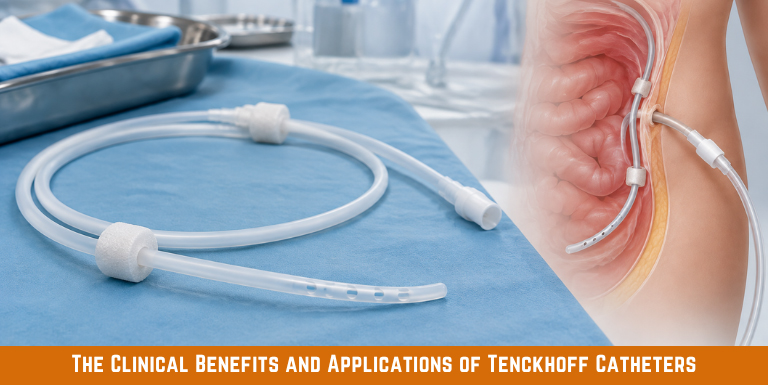
The Tenckhoff catheter remains the most widely used access device for chronic peritoneal dialysis, and most modern peritoneal dialysis catheters, including the swan neck variant, are built directly on its original design. The catheter is made of silicone rubber and includes one or two porous cuffs positioned along its length. Once implanted into the abdominal wall, surrounding tissue grows into these cuffs, anchoring the catheter securely and permanently in place while also helping to seal the tunnel against bacterial entry. This anchoring mechanism is a large part of why the design has remained the clinical standard for decades, even as newer variants have been introduced.
A typical double cuff straight Tenckhoff catheter runs about 40 centimeters in total length, divided into an intraperitoneal segment of roughly 15 centimeters, an intramural segment of about 5 to 7 centimeters that passes through the abdominal wall, and an external segment of around 16 centimeters that remains outside the body for connection to the dialysis system. The intraperitoneal portion is open ended and includes multiple small side openings along its terminal segment, allowing dialysate to flow in and drain out efficiently. Most catheters also include a barium impregnated radiopaque stripe running the full length, which allows the position to be confirmed radiographically when needed.
Double cuff catheters are now used in more than 90 percent of peritoneal dialysis cases, and for good clinical reason. Compared with single cuff catheters, the double cuff design is associated with fewer complications, a longer interval before the first episode of peritonitis, and better overall catheter survival. The second cuff, positioned closer to the skin exit site, adds an additional barrier against bacteria tracking along the tunnel toward the peritoneal cavity, which is the primary route by which most catheter related infections occur.
Hospitals and distributors stocking peritoneal dialysis consumables should treat the double cuff design as the default option for most patients, reserving single cuff catheters for the specific clinical situations where a physician determines a shorter tunnel or a temporary access is more appropriate.
 Email Us Today!
Beyond the number of cuffs, the shape of the segment that sits inside the peritoneal cavity is another major design variable. A straight Tenckhoff catheter has a simple, linear intraperitoneal segment, while a coiled catheter forms a loose spiral at its tip. The coiled design is thought to reduce infusion and pressure related pain during dialysate exchange by distributing flow more evenly and keeping the catheter tip further from the bowel and abdominal wall, though clinical trials comparing straight and coiled catheters have shown mixed results on infection rates and long term catheter survival, with some studies finding no significant difference between the two.
This is a useful point for hospitals to understand when building their procurement list. Rather than treating coiled catheters as a universal upgrade, most nephrology teams choose between straight and coiled designs based on physician preference and the individual patient’s anatomy, which means a supplier offering both configurations gives the hospital more flexibility than one offering only a single design.
The swan neck catheter is a modified version of the standard Tenckhoff design, built with the same intraperitoneal segment but featuring a permanent arcuate bend in the subcutaneous tunnel between the two cuffs. This bend allows the catheter to be placed with the tunnel and exit site directed downward, regardless of the angle at which the catheter exits the peritoneal cavity, which helps reduce the incidence of cuff extrusion, a complication where the external cuff migrates out toward the skin surface. Studies comparing swan neck and straight Tenckhoff catheters have generally found a similar risk of peritonitis and exit site infection between the two, but a meaningfully lower rate of cuff extrusion with the swan neck design, which in turn supports longer catheter survival.
One of the more common mechanical complications with peritoneal dialysis catheters is tip migration, where the catheter tip drifts out of the pelvis and into the upper abdomen, reducing drainage efficiency. Straight catheters are associated with a higher incidence of tip migration compared with catheters that include a permanent bend, which is one of the reasons surgical teams place particular emphasis on directing the catheter tip toward the pelvis during implantation. Hospitals training new surgical staff on catheter placement should factor this into technique protocols rather than treating placement as a simple, low variability step.
Silicone rubber has remained the material of choice for Tenckhoff catheters largely because of its flexibility and long term biocompatibility, both of which matter enormously for a device that may stay implanted for years rather than days. A catheter that is too rigid increases the risk of bowel or bladder perforation during placement or later movement inside the abdomen, while one that is too soft can kink under normal patient movement and obstruct dialysate flow. Manufacturers balance these properties by controlling the durometer of the silicone used and by reinforcing the intramural segment where the catheter passes through the abdominal wall, an area subject to more mechanical stress than the free floating intraperitoneal portion.
Surface finish also affects how the catheter tolerates years of dialysate exposure. A smooth, consistent silicone surface resists the buildup of fibrin and biofilm better than a rougher one, which in turn reduces the chance of catheter obstruction requiring intervention. Hospitals evaluating suppliers should ask about the specific silicone grade used and whether the manufacturer tests for long term flexibility retention, since a catheter that stiffens over months of use can contribute to the mechanical complications discussed earlier.
Our Other Product
Long Term Hemodialysis Catheters Kit
Procurement teams sourcing Tenckhoff catheters should first confirm the supplier offers a genuine range of configurations, including single and double cuff, straight and coiled tips, and standard versus swan neck tunnel designs, since no single configuration suits every patient. Second, catheter length options matter, particularly for pediatric patients or for hospitals serving a wide range of body types, so a supplier limited to one standard adult length restricts clinical flexibility. Third, since peritoneal dialysis catheters remain implanted for extended periods, sometimes years, documentation of the silicone material’s biocompatibility and the manufacturer’s quality and regulatory compliance for long term implantable devices should be part of any supplier evaluation.
St Stone Medical Devices manufactures Tenckhoff catheters in both single and double cuff configurations, with straight and coiled intraperitoneal segment options, supplying hospitals and distributors who need a dependable range of peritoneal dialysis access devices for varied patient needs.
Peritoneal dialysis programs depend on a steady, uninterrupted supply of catheters and related consumables, since a scheduled implantation cannot simply be postponed if the required configuration is out of stock. Distributors serving multiple nephrology centers across a region need a manufacturing partner capable of maintaining consistent production across all cuff, tip, and length variants simultaneously, rather than one that produces certain configurations only in occasional batches. This becomes especially important for hospitals running growing home dialysis programs, where the mix of patients, and therefore the mix of catheter types required, tends to shift over time as more patients transition onto peritoneal dialysis.
Even the best designed Tenckhoff catheter depends heavily on how the exit site is cared for after implantation, since the tunnel and exit site remain the primary route through which infection can reach the peritoneal cavity. Proper healing in the weeks immediately following placement, before the patient begins full dialysate exchanges, sets the foundation for the cuffs to become properly incorporated into surrounding tissue. Hospitals and training teams that pair catheter placement with a structured exit site care protocol, including regular cleaning technique, immobilization of the external segment to prevent tension on the tunnel, and early recognition of exit site infection signs, tend to see better long term catheter survival than those treating the catheter itself as the only variable that matters.
This is a useful point for hospitals to communicate clearly when training new nephrology staff or when onboarding patients onto home peritoneal dialysis, since the catheter, however well engineered, functions as part of a broader system that includes patient technique and ongoing site care.
 Call Now
Standard adult length Tenckhoff catheters are not appropriate for pediatric patients or for smaller adults, where the standard intraperitoneal and tunnel segment lengths can leave the catheter tip poorly positioned within the pelvis. Manufacturers producing pediatric length catheters, alongside standard adult sizes, allow nephrology programs treating children or smaller framed patients to select a length matched to the patient’s actual abdominal cavity dimensions rather than adapting an adult catheter through surgical technique alone. Hospitals running a pediatric dialysis program should treat catheter length range as a core evaluation criterion when selecting a supplier, not an afterthought handled through special order requests.
The Tenckhoff catheter has remained the foundation of peritoneal dialysis access for good reason, but the design decisions built around it, cuff number, tip shape, and tunnel configuration, all carry real clinical consequences for infection risk, catheter survival, and patient comfort. Hospitals and distributors that understand these variants are better positioned to stock the right mix of catheters for their patient population rather than defaulting to a single configuration for every case. St Stone Medical Devices continues to support nephrology departments with a full range of Tenckhoff catheter configurations built to these clinical standards.
We are recognized as one of the leading manufacturers, exporters, and suppliers of a diverse range of high-quality medical devices in India. Our products, including Interventional Cardiology, Nephrology, Anaesthesia, General Consumables, and Critical Care Accessories, are designed to meet the highest standards of excellence, ensuring reliable performance and patient care.
A – 8, Kuraopokpi industrial Estate,
Thoubal (kakching) Imphal,
Manipur – 795001, India.