Read Our Article
How PICC Kit Manufacturers Are Meeting Global Demand for Quality IV Access Devices

When patients undergo chemotherapy cycles, prolonged antibiotic therapy or parenteral nutrition, repeated peripheral venipuncture quickly becomes a clinical and humanistic problem – collapsed veins, limited access and compounding patient distress. The peripherally inserted central catheter has redefined how clinicians approach intravenous access in these scenarios, shifting care from reactive and painful to proactive and sustainable.
A peripherally inserted central catheter is a long, thin catheter inserted through a peripheral vein – most commonly the basilic, cephalic or median cubital vein in the arm – and advanced until its tip rests in the superior vena cava, just outside the right atrium. This anatomical positioning is what separates a PICC line catheter from a standard peripheral IV: the high-flow, high-volume blood environment near the heart rapidly dilutes concentrated or cytotoxic infusates, dramatically reducing the risk of chemical phlebitis and vessel damage.
In oncology settings, this is non-negotiable. Chemotherapy agents such as anthracyclines and vinca alkaloids are highly vesicant – direct contact with peripheral vessel walls causes necrosis. The peripheral central catheter’s design places drug delivery past these vulnerable segments entirely. The same logic applies to hyperosmolar parenteral nutrition solutions and high-dose vasopressors in critical care.
 Call Now
The evolution of PICC line products from simple silicone tubes to sophisticated polyurethane-based systems reflects the clinical demands placed on them. Polyurethane – the material used in advanced peripherally inserted central catheters like the CENTVENT PICC range – is biostable, kink-resistant and softens at body temperature, reducing mechanical irritation to vessel walls over extended dwell times exceeding 30 days.
Modern PICC kits come configured as single or double lumen systems. The choice between them is clinically driven: a single lumen picc catheter suits patients receiving one continuous infusion, while double lumen configurations allow simultaneous administration of incompatible drugs or concurrent blood sampling without cross-contamination. Hospitals managing high-volume oncology or ICU caseloads increasingly standardise on double lumen picc line sets to support complex, multidrug regimens within one access point.
A well-designed PICC-Peripherally Inserted Central Catheter Kit does more than supply the catheter itself. The clinical reality of PICC insertion is that success depends as much on the ancillary components as on the catheter’s material quality. A comprehensive picc kit typically includes the PICC catheter in the specified French size and lumen configuration, an introducer needle, a guidewire, a peel-away dilator and sheath, a securement device or suture wing, sterile draping, flush syringes and extension lines with clamps.
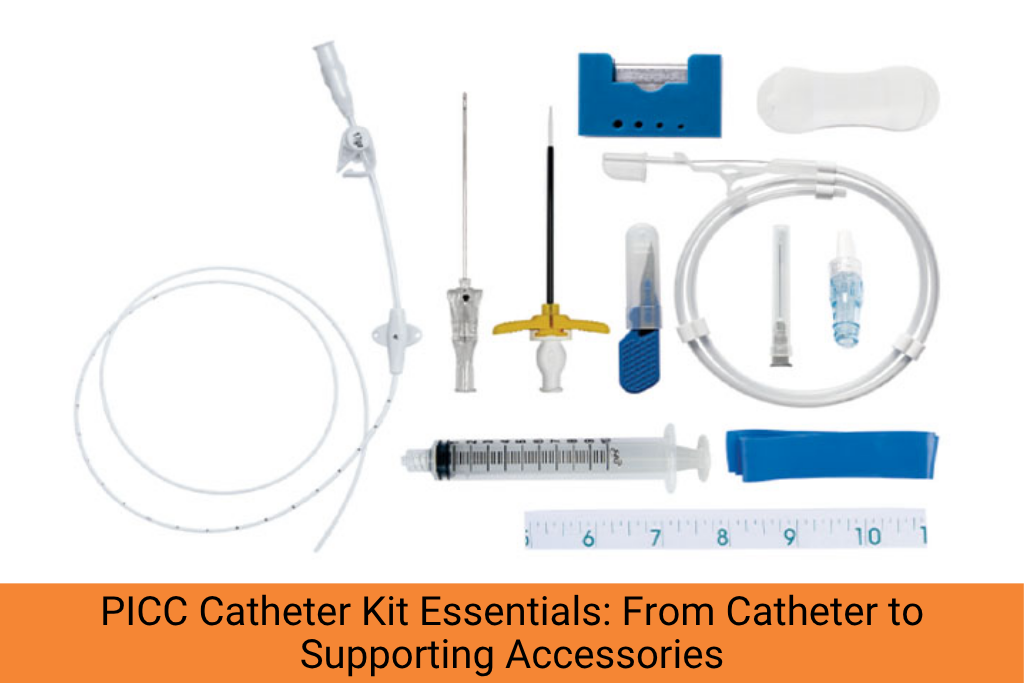
Standardised kit packaging reduces the chance of missing components during time-sensitive insertions, ensures sterility compliance across the procedure and simplifies inventory management for procurement teams. For institutions operating high-turnover oncology or critical care wards, kit-based procurement from a reliable peripherally inserted central catheter bulk supplier is both a quality and an efficiency decision.
The most visible transformation driven by the peripheral central catheter is in the patient experience during multi-cycle chemotherapy. A typical solid tumour regimen may span 4–6 months with infusion sessions every 2–3 weeks. Without a central venous access device, each session involves a new peripheral cannula, often increasingly difficult to place as treatment progresses and veins become fibrosed.
With a PICC line catheter inserted once at the outset, the patient arrives for each cycle with a reliable, patent access point already in situ. Nurses reduce pre-infusion preparation time, patients avoid repeated needlesticks and the risk of extravasation – a serious complication where cytotoxic agents leak into surrounding tissue – drops substantially. In paediatric oncology, where venous access is technically demanding and psychologically traumatic, the picc catheter’s single-insertion model has become a standard of care in many centres.
Beyond chemotherapy, the same logic applies to patients requiring prolonged antibiotic courses for osteomyelitis, endocarditis or post-surgical infections where intravenous therapy must continue after hospital discharge. Home infusion programs are built around the picc line set’s ability to function reliably in non-clinical environments with appropriate training.
Our Other Product
Central Venous Catheter KitSelecting among PICC manufacturers involves more than unit pricing. The catheter’s material composition, tip configuration, lumen internal diameter, French size range and biocompatibility certification are the baseline clinical criteria. Equally, regulatory compliance – CE marking, ISO 13485 quality management certification, WHO-GMP compliance – signals that a manufacturer’s production environment meets the standards required for medical devices used in immunocompromised or critically ill populations.
Radiopaque tip markers are a critical safety feature – they allow post-insertion fluoroscopic or chest X-ray confirmation that the catheter tip has not migrated to a sub-optimal position such as the internal jugular vein or the right atrium. This is not a premium add-on; it is a clinical necessity.
For institutional buyers and distributors seeking a peripherally inserted central catheter manufacturers, the ability to deliver consistent quality across large order volumes, support regulatory documentation requirements and provide reliable lead times are operational priorities that should carry equal weight alongside price.
Critical care environments place distinct demands on the picc line set. Patients with severe burns or traumatic injuries affecting the chest and neck – the conventional sites for subclavian or internal jugular central lines – require alternative vascular access strategies. Here the peripheral central catheter offers a clinically safe route that avoids compromised anatomical zones entirely.
Haemodynamically unstable ICU patients receiving concurrent vasopressor infusions, total parenteral nutrition and multiple antibiotic lines benefit from double lumen picc catheter configurations that maintain line segregation. The reduced procedural risk compared to surgically placed tunnelled catheters also makes the picc catheter a preferred transitional option while clinicians assess whether a longer-term implanted port is warranted.
In patients awaiting radiotherapy to the thoracic region, a peripherally inserted central catheter avoids the radiation field that would compromise a subclavian or jugular central line placement, preserving both vascular access and treatment planning.
 Email Us Today!
St. Stone Medical Devices Pvt. Ltd., a New Delhi-based manufacturer and distributor of medical devices incorporated in 2012, with its manufacturing plant operational in North East India since 2014. The company holds ISO 13485:2016, ISO 9001:2015, CE and WHO-GMP certifications and is a recognised exporter to approximately 20 countries across Africa, the Middle East and Asia. Its product portfolio spans interventional cardiology consumables, nephrology devices, critical care accessories – including the PICC-Peripherally Inserted Central Catheter Kit under the CENTVENT range – anaesthesia products and general disposables.
Our Other Product
Spinal NeedleThe peripherally inserted central catheter has moved from a niche access device to a cornerstone of modern chemotherapy delivery and critical care management. Its clinical impact – reducing vessel damage, enabling prolonged therapy, supporting home infusion and eliminating repeated cannulation – is measurable in both patient outcomes and operational efficiency. As demand grows, sourcing decisions around PICC line products, picc kits and picc catheter configurations from qualified, certified manufacturers and bulk suppliers will remain central to delivering consistent, safe vascular access across oncology and critical care settings.
We are recognized as one of the leading manufacturers, exporters, and suppliers of a diverse range of high-quality medical devices in India. Our products, including Interventional Cardiology, Nephrology, Anaesthesia, General Consumables, and Critical Care Accessories, are designed to meet the highest standards of excellence, ensuring reliable performance and patient care.
A – 8, Kuraopokpi industrial Estate,
Thoubal (kakching) Imphal,
Manipur – 795001, India.