Read Our Article
The Role of Peritoneal Dialysis Catheters in Indonesia’s Healthcare System: Overcoming Challenges in Renal Care
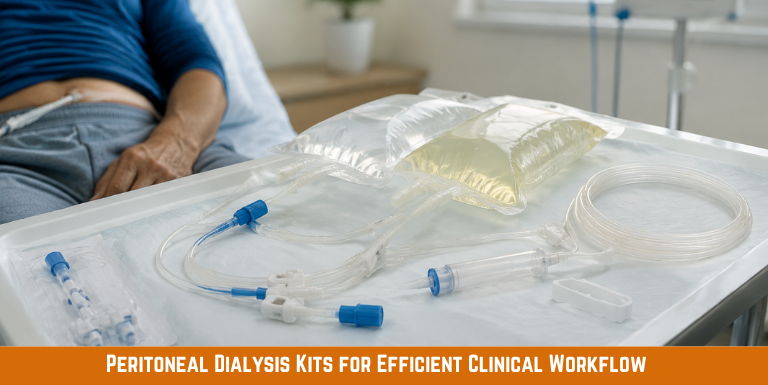
Peritoneal dialysis has become a front-line treatment option for end-stage renal disease management and behind every successful PD session lies the precision of the consumables used. Among these, the peritoneal dialysis transfer set and complete catheter kits define how efficiently and safely a clinical team can execute the therapy. As nephrology departments scale up home dialysis programs and outpatient PD services, the design and standardisation of these components have a direct impact on clinical workflow, patient safety and operational efficiency.
Peritoneal dialysis catheter selection is among the most consequential decisions in PD setup. The catheter acts as the sole conduit between the dialysis system and the peritoneal cavity, making its geometry, cuff configuration and tip design critical to long-term access viability.
The two most clinically adopted variants are the straight Tenckhoff catheter and the coiled-tip design. Swan neck peritoneal catheters, however, have gained substantial attention in contemporary practice. Their pre-formed subcutaneous arc directs the external segment downward, reducing migration risk and improving exit-site positioning – a factor directly linked to reduced infection rates. This anatomical alignment also decreases mechanical trauma at the skin tunnel, which is a recurring challenge in standard straight-segment designs.
Peritoneal coil catheters, on the other hand, are primarily used in paediatric patients or in adults where intra-abdominal positioning is difficult. The coiled tip disperses inflow and outflow across a wider surface area within the peritoneal cavity, reducing jet-effect trauma to the omentum and bowel wall. This is particularly relevant in patients who have undergone prior abdominal surgeries.
 Call Now!
The peritoneal dialysis transfer set is the critical link between the implanted catheter and the external dialysis bag system. It determines how easily the exchange process can be performed, whether in a clinical setting or during home-based continuous ambulatory peritoneal dialysis (CAPD).
Modern transfer sets are engineered with integrated flush-before-fill mechanisms, antimicrobial protective caps and luer-lock or spike-tip connectors that reduce contamination risk at each exchange. The set incorporates tubing of defined internal diameter to control flow rate, which in turn regulates dwell time accuracy – a pharmacodynamic variable that directly affects dialysis adequacy (Kt/V).
For clinical staff, the standardisation of transfer set design simplifies training protocols. A consistent connection mechanism across patient cohorts reduces procedural errors during shift handovers and reduces the cognitive load on nurses managing multiple PD patients simultaneously. In high-throughput nephrology wards, this standardisation translates directly into faster, safer exchanges.
The titanium adapter – often included in advanced transfer set configurations – provides a durable, corrosion-resistant coupling point between the peritoneal catheter and the transfer tubing, extending the life of the external circuit while maintaining connection integrity.
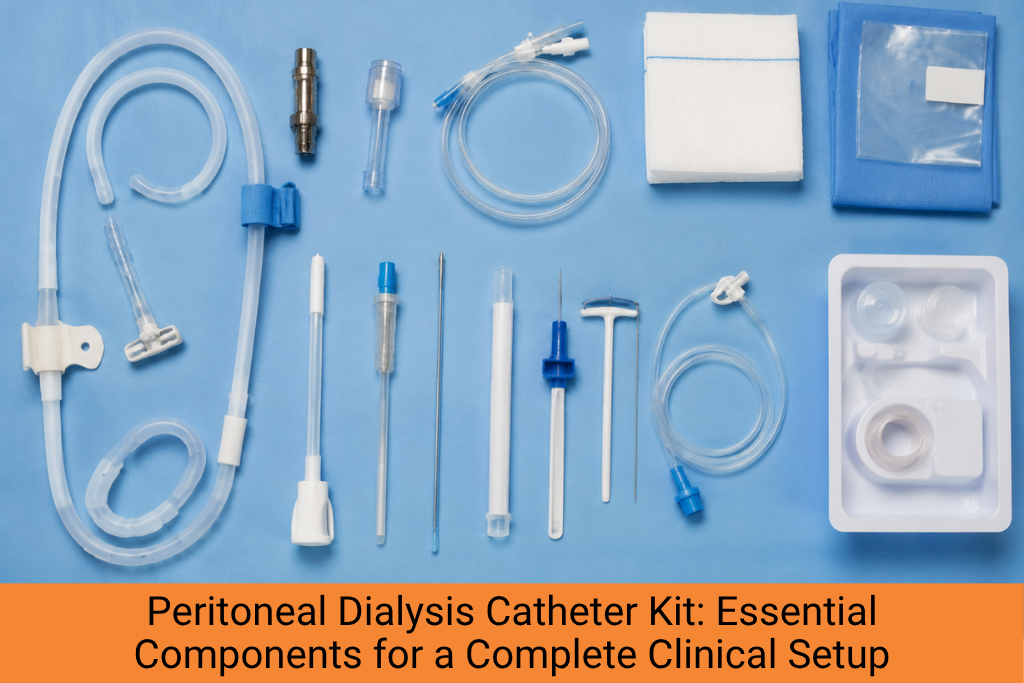
A peritoneal dialysis catheter kit is not simply a catheter in packaging. A well-configured kit consolidates all insertion-procedure components into a single sterile unit, reducing the time clinical staff spend sourcing individual items and lowering the risk of assembly-related contamination.
A comprehensive peritoneal dialysis kit typically includes the PD catheter (straight or swan neck coil design), a titanium adapter, a transfer set, mini caps, connecting tubing and procedural accessories such as the introducer, stylet and tunnelling device. Some kits also integrate iodine-based protective caps or povidone-iodine solution sachets to support aseptic technique at the exit site.
For nephrologists and interventional radiologists performing catheter insertions, the kit format reduces surgical prep time significantly. Every component is pre-selected, sterile and compatible – eliminating last-minute substitutions that can compromise procedural flow or introduce compatibility risks between components from different manufacturers.
The peritoneal dialysis kit also plays a role in inventory management. Hospital procurement teams prefer kit-based purchasing because it simplifies SKU tracking, reduces storage complexity and ensures consistent supply of all necessary components without fragmented vendor management.
Our Other Product
Peritoneal Dialysis CatheterThe peritoneal catheter placement procedure, whether performed via open surgical technique, percutaneous (Seldinger) method or laparoscopic approach, requires coordinated preparation that begins well before the patient enters the procedure room.
Standardised peritoneal dialysis catheter kits support this preparation by providing a single unboxing workflow rather than a multi-tray setup. In busy dialysis units or outpatient surgical centres, this pre-procedural efficiency directly affects scheduling capacity.
Post-insertion, the transfer set configuration also affects the break-in period management. Most current protocols recommend a two-to-four-week break-in period using low-volume exchanges before full-dose CAPD or APD (automated peritoneal dialysis) begins. The design of the transfer set – specifically its flow characteristics and the compatibility of its connector with the titanium adapter – determines how smoothly low-volume flushes can be performed without resistance or positional dysfunction.
Nursing staff responsible for exit-site care and transfer set changes rely on the ergonomics of the set design: one-handed operation capability, clear colour coding for inflow/outflow and audible or tactile confirmation of locking connections. These seemingly minor design variables have measurable effects on compliance and infection rates over long treatment durations.
Choosing the right peritoneal dialysis catheter manufacturer involves more than product specification review. It requires evaluating regulatory compliance, quality management systems, customisation capability and supply chain reliability – particularly for hospitals managing large PD patient populations or running home dialysis programmes across multiple regions.
A peritoneal dialysis catheter supplier operating with CDSCO licensing and conforming to ISO 13485 quality standards offers a baseline of product consistency that protects clinical teams from batch-to-batch variability. Biocompatibility testing, silicone grade certification and accelerated ageing studies are documentation elements that procurement and clinical engineering teams should actively request.
For international buyers, a supplier’s export track record, documentation support for customs clearance and ability to provide CE-marked or country-specific regulatory documentation matter significantly. A reliable peritoneal dialysis catheters supplier who can offer both standard and custom configurations – varied cuff numbers, lengths and tip styles – gives nephrology programmes the flexibility to standardise across patient sub-groups rather than maintaining separate purchasing streams for adult, paediatric and obese patient categories.
St. Stone Medical Devices Pvt. Ltd., established in 2012 and headquartered in India, is a CDSCO-licensed manufacturer and exporter of a wide range of medical devices, with a strong focus on nephrology and dialysis products. The company produces peritoneal dialysis catheters, swan neck coil catheters, transfer sets, titanium adapters and complete PD kits, alongside hemodialysis catheters, urology devices and interventional cardiology consumables. Operating from a state-of-the-art manufacturing facility and holding licensing from both CDSCO and the State Drug Authority, STS Medicals serves both domestic and international markets.
Our Other Product
Titanium AdapterPeritoneal dialysis transfer sets and catheter kits are not peripheral accessories – they are operational infrastructure for any nephrology programme running PD therapy at scale. The right peritoneal catheter design, paired with a well-configured transfer set and a complete kit format, reduces procedural time, lowers infection risk and supports clinical staff in delivering consistent, protocol-aligned care. Selecting a qualified peritoneal dialysis catheter manufacturer with verified compliance, product range depth and supply chain stability ensures that these operational gains are sustainable across patient cohorts and treatment settings.
We are recognized as one of the leading manufacturers, exporters, and suppliers of a diverse range of high-quality medical devices in India. Our products, including Interventional Cardiology, Nephrology, Anaesthesia, General Consumables, and Critical Care Accessories, are designed to meet the highest standards of excellence, ensuring reliable performance and patient care.
A – 8, Kuraopokpi industrial Estate,
Thoubal (kakching) Imphal,
Manipur – 795001, India.