Read Our Article
The Role of AV Fistula Needles in Achieving Optimal Blood Flow for Hemodialysis
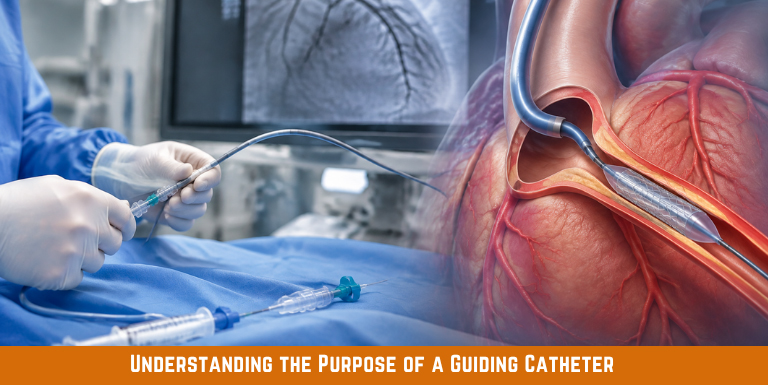
A guiding catheter is the larger bore catheter that sits at the entrance of the coronary artery during a percutaneous coronary intervention, providing a stable channel through which balloons, stents, and other interventional devices are delivered to the lesion. Unlike a diagnostic catheter, which only needs to sit passively while contrast flows through it, a guiding catheter has to hold its position at the coronary ostium while the operator pushes a balloon or stent system against real resistance from the vessel and the lesion itself. If the guiding catheter slips backward out of the ostium during this push, the device cannot be advanced and the procedure stalls.
This resistance to slipping backward is what interventional cardiologists call backup support, and it is the single most important performance characteristic separating one guiding catheter from another. Understanding how backup support is generated helps explain why cath labs need more than one guiding catheter shape on the shelf.
Backup support comes from two sources, generally described as passive and active. Passive support comes from the catheter’s shape, stiffness, and size allowing the secondary curve of the catheter to rest firmly against the aortic wall opposite the target coronary ostium without any additional manipulation from the operator. Active support requires the operator to deliberately position the catheter tip deeper into the ostium to generate additional holding force. The angle formed between the catheter and the opposite aortic wall matters considerably here, with support generally strongest when that angle approaches ninety degrees, and the amount of aortic wall surface area the secondary curve rests against also contributes to how much backup force is available.
This is why guiding catheter shapes are not arbitrary. Each shape, whether Judkins, Amplatz, or one of the many extra backup designs developed since, represents a specific tradeoff between how easily the catheter engages the ostium and how much support it provides once seated there.
 Email Us Now!
Judkins shaped guiding catheters are considered a conservative design. Their curve is flexible and engages the coronary ostium only minimally, which is gentle on the vessel but offers comparatively less backup support, increasing the chance that a difficult lesion cannot be crossed on the first attempt. Amplatz and Voda type catheters take a more aggressive approach, seating deeper into the ostium to provide much stronger backup support, but this deeper engagement raises the risk of vessel trauma or dissection if the catheter is not handled carefully. Neither approach is correct for every case, which is exactly why most cath labs stock both families rather than standardizing on one.
Because patient anatomy varies so widely, particularly the angle at which the coronary arteries originate from the aorta, operators often need to try more than one catheter shape before finding the one that seats well for a given patient. A cath lab with a narrow guiding catheter inventory effectively narrows the operator’s options at exactly the moment flexibility matters most.
Beyond the standard Judkins and Amplatz families, manufacturers have developed a range of extra backup shapes specifically for the left coronary artery, designed for patients with a short or absent left main artery or an unusually angular circumflex origin. These extra backup catheters typically provide more support than a standard Judkins left while remaining gentler than an Amplatz, occupying a useful middle ground for operators handling complex left sided anatomy. Similar specialized shapes exist for the right coronary artery, including hockey stick and Amplatz right configurations, used when the standard Judkins right does not provide enough support in a larger or unusually shaped aorta.
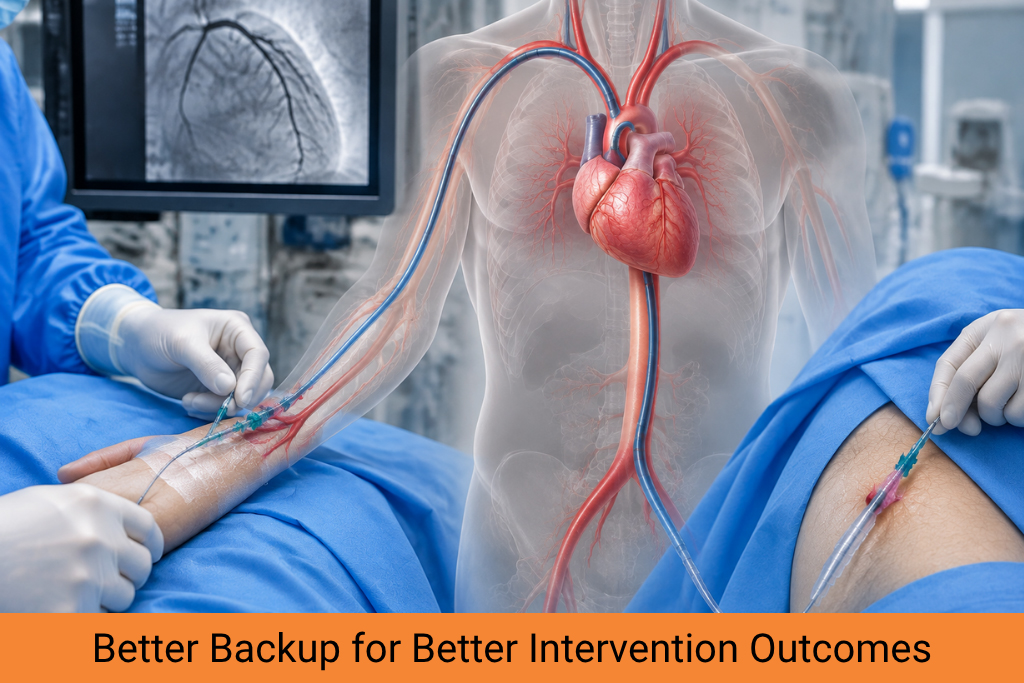
The growth of radial access has added another layer to guiding catheter selection. Research comparing backup force across access routes has found that catheters behave differently depending on whether they are advanced from the femoral or the radial artery, largely because the primary point where the catheter contacts the arterial wall differs between the two approaches. In transfemoral procedures the catheter typically draws support from the aortic arch, while in transradial right coronary interventions the brachiocephalic artery often becomes the primary support point instead. This means a guiding catheter shape that performs well from femoral access does not always deliver the same backup force when used radially, which is worth factoring into inventory planning for cath labs that have shifted primarily toward radial access.
Beyond shape, the physical construction of the catheter shaft affects both support and usability. Many guiding catheters use a hybrid braided construction that allows a thinner catheter wall without sacrificing torque control or backup strength, which is particularly valuable for radial procedures where a smaller outer diameter is preferred. A multi segment design, combining a softer, more flexible segment near the tip with a firmer shaft further back, helps the catheter cannulate the ostium gently while still transmitting enough force along its length to resist backing out during device delivery. A PTFE inner lining reduces friction, making it easier to advance balloons and stents through the catheter lumen without excessive resistance.
Our Other Product
Blood Line Set for HemodialysisA guiding catheter that loses its preformed curve during a lengthy or complex intervention becomes progressively less effective at maintaining backup support, since the mechanism relies on the catheter’s shape holding firm against the aortic wall throughout the case. Repeated device exchanges, prolonged procedure time, and manipulation while seeking the correct engagement can all place cumulative stress on the catheter shaft. Manufacturers address this through material selection and multi segment construction designed specifically to resist shape distortion over the full duration of a case, which becomes especially relevant for complex interventions such as chronic total occlusion procedures that can run considerably longer than routine angioplasty.
Procurement teams sourcing guiding catheters should confirm the supplier’s range covers the core shape families, Judkins left and right, Amplatz left and right, and at minimum one extra backup option, rather than a single generic shape marketed as universal. Second, French size range matters, since guiding catheters typically run from 5 to 8 French depending on the devices they need to accommodate, and a cath lab performing complex interventions with larger delivery systems needs access to the higher end of that range. Third, given that backup support is a mechanical property, documentation of shaft construction, including braiding type and wall thickness, gives procurement teams a more reliable basis for comparison than shape name alone. Fourth, distributors serving hospitals with both high volume routine cases and a growing complex or chronic total occlusion program should stock extra backup shapes in sufficient quantity, since these cases place greater demands on catheter performance and cannot rely on standard shapes alone.
St Stone Medical Devices manufactures guiding catheters across the standard Judkins and Amplatz shape families, with a range of French sizes and hybrid braided construction for reliable backup support, supplying hospitals and distributors who need dependable interventional catheters for varied coronary anatomy.
Chronic total occlusion procedures place unusually high demands on guiding catheter support, since crossing a fully blocked vessel often requires significant forward force applied through the guidewire and microcatheter system, all of which is transmitted back through the guiding catheter. Operators performing a high volume of complex, chronic total occlusion cases frequently rely on the more aggressive backup shapes almost by default, and some centers stock dedicated extra support guiding catheters specifically reserved for these cases rather than mixing them into general inventory. Hospitals building out a structured complex PCI program should treat guiding catheter selection as part of that program’s core equipment planning, alongside microcatheters and specialty guidewires, rather than assuming the standard catheter inventory used for routine cases will translate well to these more demanding procedures.
 Call Us Now!
Some guiding catheters are manufactured with side holes near the distal tip, allowing a degree of blood flow to continue past the catheter even while it is deeply seated in the coronary ostium. This design is used selectively in situations where deep engagement is needed for backup support but where the operator is concerned about compromising blood flow to the vessel during a prolonged procedure, such as certain saphenous vein graft interventions. Side hole catheters are a more specialized item that not every cath lab needs to stock in volume, but hospitals performing bypass graft interventions with any regularity should confirm their supplier can provide this configuration rather than discovering the gap during a case that calls for it.
A guiding catheter has to do more than simply reach the coronary ostium, it has to hold its position there under real mechanical resistance while the interventional team delivers a device to the lesion. The difference between a conservative Judkins shape and an aggressive Amplatz shape, and the many variations built around them, reflects a genuine clinical tradeoff between ease of engagement and backup strength that operators navigate case by case. Hospitals and distributors that stock a genuine range of shapes and sizes give their interventional teams the flexibility to match the catheter to the anatomy rather than the other way around, and St Stone Medical Devices continues to support cath labs with guiding catheters built around this clinical reality.
We are recognized as one of the leading manufacturers, exporters, and suppliers of a diverse range of high-quality medical devices in India. Our products, including Interventional Cardiology, Nephrology, Anaesthesia, General Consumables, and Critical Care Accessories, are designed to meet the highest standards of excellence, ensuring reliable performance and patient care.
A – 8, Kuraopokpi industrial Estate,
Thoubal (kakching) Imphal,
Manipur – 795001, India.