Read Our Article
How to Prevent Complications with the Short-Term Hemodialysis Catheter Kit: Tips for Medical Staff?

A central venous catheter, often referred to as a CVC, is a thin flexible tube inserted into a large central vein to provide reliable vascular access for patients who require ongoing medical treatment. Unlike a standard peripheral IV line placed in a small vein of the arm, a central venous catheter reaches deep into the venous system, allowing clinicians to deliver fluids, medications, and nutrition directly and safely.
For hospitals, ICU departments, and oncology centers, the central venous catheter is one of the most frequently used critical care devices. Understanding how it works, where it is placed, and what quality standards govern its manufacturing helps procurement teams and clinicians make informed sourcing decisions.
A central venous catheter serves several clinical purposes at once. It is commonly used to administer intravenous fluids and medications that would irritate smaller peripheral veins, deliver chemotherapy drugs over extended treatment cycles, provide parenteral nutrition to patients who cannot eat normally, and draw blood samples without repeated needle sticks.
It also allows continuous monitoring of central venous pressure, which gives physicians real time information about a patient’s fluid status and cardiac function, particularly important in intensive care and post surgical settings where hemodynamic stability needs close observation.
Central venous catheters are typically inserted into one of three large veins, the internal jugular vein in the neck, the subclavian vein beneath the collarbone, or the femoral vein in the groin. The choice of insertion site depends on the patient’s condition, the expected duration of treatment, and the clinician’s assessment of infection and bleeding risk.
The procedure is generally performed under ultrasound guidance to visualize the vein and reduce the risk of accidental puncture of nearby structures such as arteries or the lung. Correct catheter tip placement, usually confirmed with an X ray or fluoroscopy, is essential before the line is used for infusion.
Central venous catheters are broadly categorized by how long they are intended to remain in place. Short term, non tunneled catheters are used for days to a few weeks in acute care settings such as an ICU. Tunneled catheters are designed for longer term use, often several weeks to months, and are passed under the skin before entering the vein, which helps reduce infection risk and improves stability.
Peripherally inserted central catheters, commonly known as PICC lines, are inserted through a vein in the arm and threaded into a central vein, offering a less invasive option for patients needing medium term intravenous therapy. Implantable ports represent a further category, placed entirely under the skin for patients requiring long term, intermittent access such as chemotherapy over many months.
Each category involves a different balance of insertion complexity, patient comfort, and infection risk over time. Tunneled and implanted devices generally carry a lower daily infection risk than non tunneled catheters because the exit site is positioned away from the vein entry point, but they require a dedicated placement procedure, often performed in an interventional radiology or minor procedure suite rather than at the bedside.
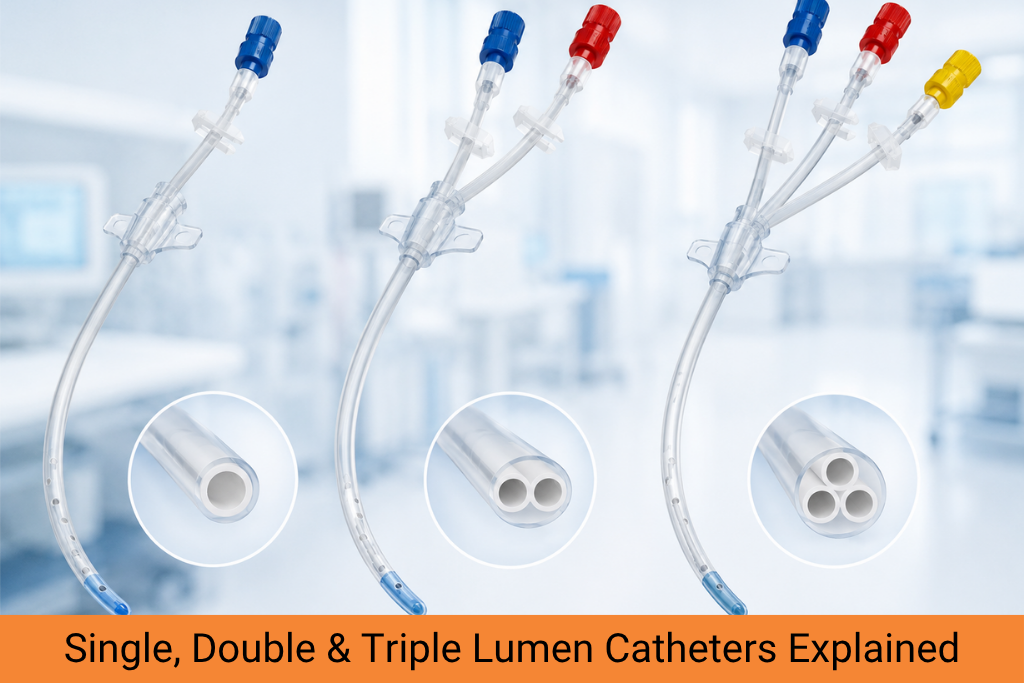
Central venous catheters are also classified by the number of internal channels, or lumens, they contain. A single lumen catheter offers one pathway for infusion or blood draw, suited to patients with a single treatment need. Double lumen catheters allow two separate infusions or a combination of infusion and blood sampling without interrupting either function.
Our Other Product
Long Term Hemodialysis Catheters KitTriple lumen catheters provide three independent channels, commonly used in intensive care for patients requiring simultaneous administration of multiple medications, fluids, and central venous pressure monitoring. Choosing the right lumen configuration depends on the complexity of the patient’s treatment plan and helps clinical teams avoid unnecessary additional vascular access procedures.
A complete central venous catheter kit typically includes the catheter itself, an introducer needle, a guidewire, a dilator, syringes, and a sterile drape, allowing the entire insertion procedure to be performed using components validated to work together. Using a standardized kit reduces the number of separate items a clinical team needs to gather, which supports faster, more consistent procedures, particularly in emergency and high volume settings.
Radiopaque markings on the catheter body allow the care team to confirm tip position on imaging, while soft, kink resistant materials such as medical grade polyurethane help minimize vein trauma during long term placement.
Once a central venous catheter is placed, ongoing care determines how safely it can remain in use. Nursing protocols typically include routine dressing changes using a transparent, breathable film that allows the insertion site to be visually inspected for redness or drainage without removing the dressing entirely. Injection caps and needleless connectors are cleaned with an antiseptic swab before each access to reduce the introduction of microorganisms into the line.
Flushing the catheter with saline or a heparin lock solution between uses helps prevent clot formation inside the lumen, which can otherwise block the line or increase the risk of catheter related thrombosis. Many hospitals now use standardized dressing kits and maintenance bundles to ensure this care is delivered consistently across nursing shifts, rather than relying on individual practice alone.
Our Other Product
Long Term Hemodialysis Catheters KitCentral line associated bloodstream infection remains one of the most closely monitored complications in hospital acquired infection surveillance programs worldwide. The United States Centers for Disease Control and Prevention and the World Health Organization both publish guidance on insertion bundles, including strict hand hygiene, maximal sterile barrier precautions, chlorhexidine skin antisepsis, and prompt removal of catheters that are no longer clinically necessary.
Manufacturers play a role in this effort by producing catheters and insertion kits that meet recognized biocompatibility and sterility standards, since the quality of the device itself is one of several factors that influence infection risk alongside clinical technique and post insertion care protocols.
Central venous catheters sold internationally are generally manufactured under an ISO 13485 certified quality management system and tested against catheter specific standards published by the International Organization for Standardization, covering material biocompatibility, mechanical performance, and sterilization validation. Products intended for the European market carry CE marking, while those entering the United States typically require clearance through the Food and Drug Administration’s premarket notification pathway.
Hospitals and distributors evaluating a new supplier should request documentation covering these certifications along with batch specific sterility test reports, particularly when sourcing for government tenders where compliance paperwork is often reviewed as closely as the product specifications themselves.
 Call Now!
St Stone Medical Devices Pvt Ltd manufactures central venous catheter kits in single, double, and triple lumen configurations, designed for both short term and tunneled long term use, alongside its wider range of dialysis, nephrology, and critical care consumables. The company’s manufacturing facility operates under ISO 13485 and WHO GMP certification and supplies hospitals and distributors across multiple export markets.
Healthcare providers and distributors looking for a dependable central venous catheter manufacturer with full export documentation and bulk supply capability can contact St Stone Medical Devices for product specifications, certification copies, and pricing.
The central venous catheter remains a foundational tool in critical care, oncology, and general hospital medicine, enabling safe delivery of treatment that peripheral veins cannot support. Selecting the right type, lumen configuration, and insertion approach depends on the patient’s clinical needs, while sourcing decisions should prioritize manufacturers with documented quality certifications and infection control conscious design.
For hospitals and distributors seeking a reliable central venous catheter supplier backed by internationally recognized quality standards, St Stone Medical Devices offers a complete range built for both routine and complex clinical use.
We are recognized as one of the leading manufacturers, exporters, and suppliers of a diverse range of high-quality medical devices in India. Our products, including Interventional Cardiology, Nephrology, Anaesthesia, General Consumables, and Critical Care Accessories, are designed to meet the highest standards of excellence, ensuring reliable performance and patient care.
A – 8, Kuraopokpi industrial Estate,
Thoubal (kakching) Imphal,
Manipur – 795001, India.