Read Our Article
Urology Catheters in Modern Healthcare: Double J Catheter and Foley Balloon Catheters (2-Way & 3-Way)
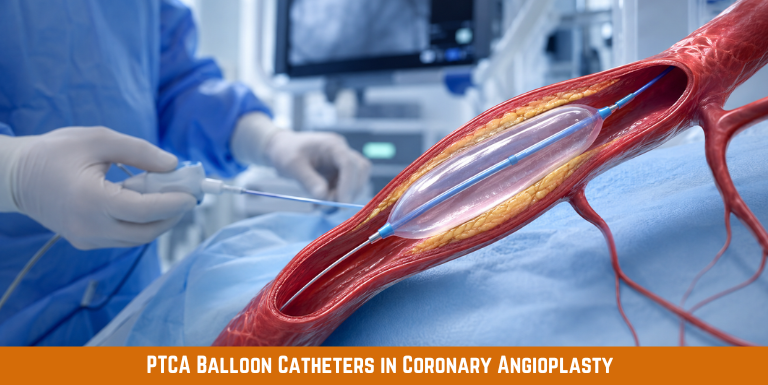
A PTCA balloon catheter, used in percutaneous transluminal coronary angioplasty, is a thin catheter with an inflatable balloon at its tip, guided through the coronary arteries to open a narrowed or blocked segment and restore blood flow to the heart muscle. It remains one of the most performed devices in interventional cardiology, used both as a standalone treatment and as preparation before stent placement.
For hospitals and distributors, understanding balloon catheter design, sizing, and the clinical scenarios each type suits helps build a procurement strategy that matches the range of coronary interventions performed in a given cathlab.
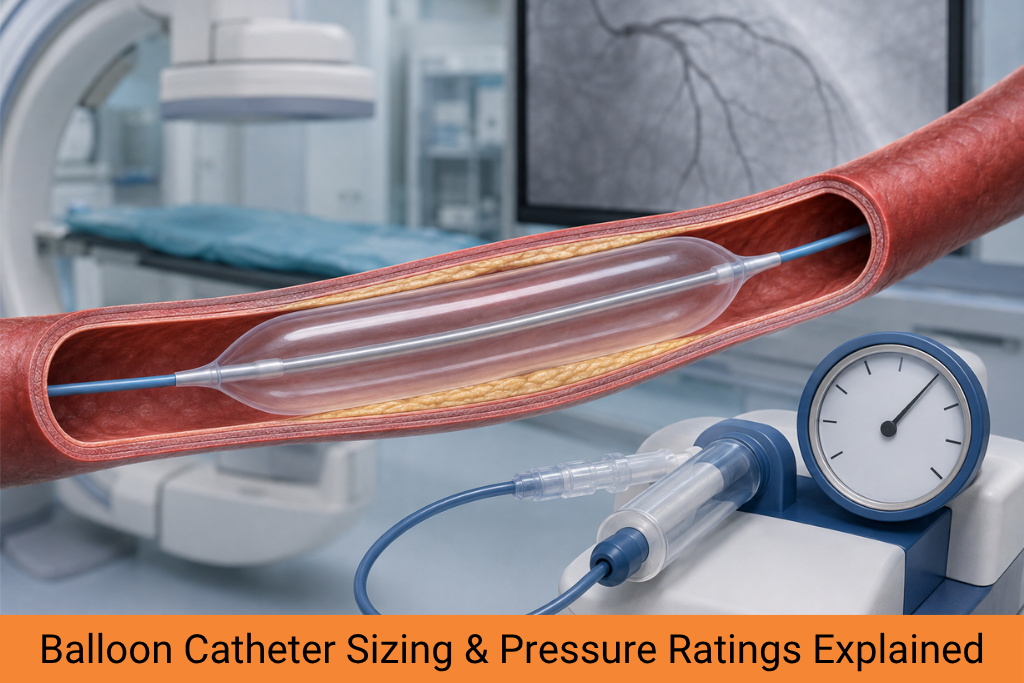
The balloon catheter is advanced over a guidewire that has already been positioned across the narrowed coronary segment, using real time fluoroscopic imaging to confirm placement. Once positioned, the balloon is inflated using an indeflator device connected to an inflation port, applying controlled pressure that compresses plaque against the artery wall and stretches the vessel to restore a wider internal diameter.
The balloon is inflated to a specific pressure for a set duration, then deflated and withdrawn, or left in place briefly if a stent mounted on the balloon needs to be expanded and seated against the arterial wall.
 Call Now
Balloon catheters are categorized by how much their diameter changes as inflation pressure increases. Compliant balloons expand more significantly with rising pressure, making them useful for gradually dilating a vessel to match its natural anatomy. Semi compliant balloons offer a moderate, predictable expansion profile and are commonly used for general lesion preparation and stent delivery.
Non compliant balloons are engineered to maintain a very precise, stable diameter even at high pressure, making them the preferred choice for post dilation of a deployed stent, where accurate sizing against the vessel wall is critical to avoid under expansion or vessel injury.
Balloon catheters are specified by diameter and length, chosen to match the target vessel segment based on angiographic measurement. Each balloon also carries a rated burst pressure, along with a nominal pressure at which the balloon reaches its labeled diameter, information printed on the packaging and referenced during the procedure using a compliance chart specific to that balloon model.
Operators select balloon length carefully to cover the full lesion while minimizing injury to healthy adjacent vessel segments, and diameter is typically matched closely to the reference vessel size measured on angiography to avoid both under treatment and vessel wall trauma from oversizing.
Longer balloons are generally reserved for diffuse disease spanning an extended vessel segment, while shorter balloons offer more precise, focal treatment for discrete lesions and reduce the risk of covering healthy tissue unnecessarily. Hospitals stocking a wide range of length and diameter combinations are better positioned to match the device to each patient’s specific angiographic findings rather than compromising on a limited inventory.
Alongside conventional balloon catheters, drug coated balloons have gained clinical adoption for treating in stent restenosis and certain small vessel or bifurcation lesions where placing an additional stent may not be ideal. These balloons carry a coating, most often paclitaxel, that transfers to the vessel wall during brief inflation, delivering a localized antiproliferative effect without leaving a permanent metal implant behind.
Hospitals building a comprehensive interventional cardiology program increasingly stock both conventional and drug coated balloon options, since clinical guidelines now recognize specific scenarios where a drug coated balloon approach offers outcomes comparable to repeat stenting while avoiding the long term risks associated with multiple layers of stent metal in the same vessel segment.
Our Other Product
Angiographic & Diagnostic CatheterBeyond the balloon itself, the catheter shaft plays a major role in procedural success. A shaft that is too stiff can be difficult to navigate through tortuous coronary anatomy, while one that is too flexible may lack the pushability needed to cross a tight or calcified lesion. Modern balloon catheters use variable stiffness shaft designs, firmer near the proximal end for control and softer near the distal tip for maneuverability through small, curved vessels.
Low balloon crossing profile, achieved through thin, tightly folded balloon material, allows the catheter to pass through severely narrowed segments that a bulkier design might not reach, which is particularly relevant in complex or previously treated lesions.
Hydrophilic coating along the distal shaft further reduces friction against the guiding catheter and vessel wall during advancement, an especially important factor in tortuous or heavily calcified anatomy where excess resistance can cause the operator to lose fine control over balloon positioning at the exact target segment.
PTCA balloon catheters are supplied pre mounted in a protective coil or straight packaging designed to prevent kinking of the balloon material during storage and transport. Each unit includes a compliance chart specific to that balloon size and model, referenced by the operator during the procedure to select the correct inflation pressure for a target diameter.
Proper cold chain and humidity controlled storage is generally recommended to preserve balloon material integrity over the product’s shelf life, and hospitals should confirm with their supplier that shipping conditions maintain these parameters throughout international transit, particularly for orders traveling long distances to reach government hospitals in remote regions.
A balloon catheter does not work in isolation. A guiding catheter provides stable access from the arterial puncture site to the origin of the coronary artery, while a dedicated coronary guidewire is advanced across the lesion first to create the pathway the balloon will follow. Compatibility between the balloon catheter’s inner lumen, the guidewire diameter, and the guiding catheter’s inner diameter must be confirmed before the procedure begins.
Hospitals stocking a range of guiding catheter shapes and guidewire stiffness levels alongside their balloon catheter inventory are better equipped to handle the anatomical variability seen across different patients and lesion types.
Our Other Product
Foley Balloon CatheterPTCA balloon catheters are manufactured under an ISO 13485 certified quality management system and tested against catheter specific standards covering burst pressure, fatigue resistance, and biocompatibility of patient contacting materials. CE marking applies to products distributed in the European market, and United States distribution generally requires clearance through the Food and Drug Administration.
Given the critical nature of coronary interventions, hospitals and tender boards typically request detailed compliance documentation, including balloon compliance charts and batch specific quality test reports, before approving a new supplier for cathlab procurement.
 Email Us Today!
St Stone Medical Devices Pvt Ltd manufactures PTCA balloon catheters alongside a wider cathlab portfolio including guiding catheters, introducer sheaths, manifolds, and radial compression devices, produced at an ISO 13485 and WHO GMP certified facility that exports to hospitals and distributors across multiple countries.
Cathlab procurement teams and distributors seeking a dependable PTCA balloon catheter manufacturer with export documentation and bulk supply capability can contact St Stone Medical Devices for compliance charts, product specifications, and pricing.
The company maintains a broad size matrix across diameter and length combinations, helping hospitals reduce the number of separate purchase orders needed to cover the full range of lesion types encountered in routine and complex coronary intervention practice.
PTCA balloon catheters remain central to coronary intervention, and their compliance type, sizing accuracy, and shaft design directly influence procedural outcomes. Hospitals and distributors sourcing these devices should prioritize suppliers who provide clear compliance data and documented regulatory certification alongside competitive pricing.
For cathlabs and distributors looking for a reliable PTCA balloon catheter supplier, St Stone Medical Devices offers a certified, export ready range designed to support the full spectrum of coronary intervention procedures, from routine angioplasty through complex, multivessel cases requiring a wide selection of balloon sizes and compliance profiles.
We are recognized as one of the leading manufacturers, exporters, and suppliers of a diverse range of high-quality medical devices in India. Our products, including Interventional Cardiology, Nephrology, Anaesthesia, General Consumables, and Critical Care Accessories, are designed to meet the highest standards of excellence, ensuring reliable performance and patient care.
A – 8, Kuraopokpi industrial Estate,
Thoubal (kakching) Imphal,
Manipur – 795001, India.