Read Our Article
Hydrophilic Guidewires for Pediatric Procedures: Challenges and Solutions
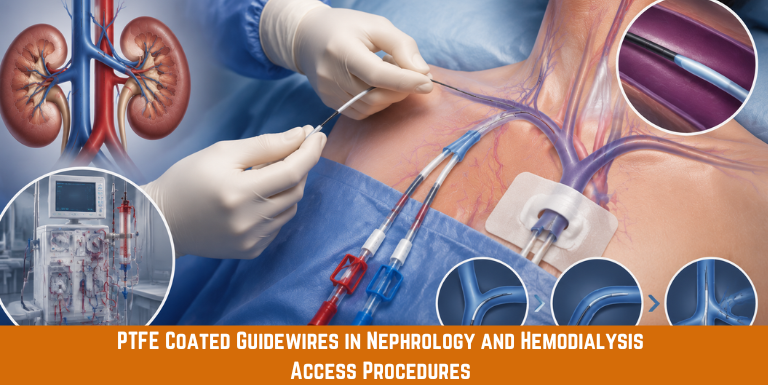
In nephrology and hemodialysis access, vascular navigation accuracy directly impacts patient outcomes. PTFE coated guidewires have become a procedural standard in renal interventions, primarily because of their ability to traverse complex venous anatomy with minimal friction and vessel trauma. From establishing central venous access to maintaining catheter position during hemodialysis line placements, these guidewires operate at the intersection of precision engineering and clinical demand. Understanding how and where they are used in nephrology settings clarifies why their adoption has expanded steadily across dialysis centers and interventional nephrology units worldwide.
PTFE coated guidewires are routinely deployed during the placement of central venous catheters (CVCs) for hemodialysis. In both short-term and long-term access procedures, the guidewire serves as the navigational scaffold over which the catheter is advanced into the internal jugular, subclavian or femoral vein. The polytetrafluoroethylene coating on the wire surface significantly reduces frictional resistance during insertion and removal, enabling the proceduralist to steer through venous bends without excessive force. This is particularly relevant in dialysis patients who often present with calcified or stenosed vessels due to chronic kidney disease (CKD), making atraumatic guidewire passage a clinical priority rather than a preference.
 Call Us Now!
The Seldinger technique remains the gold standard for vascular access in dialysis catheter placement. A PTFE guidewire is introduced through an introducer needle into the target vessel, after which the needle is withdrawn and a dilator-sheath assembly is advanced over the wire. The lubricity of the PTFE coated guide wire reduces the risk of the wire kinking or binding during dilation, especially when navigating venous valves or bifurcations. In bedside hemodialysis catheter insertions – often performed in nephrology wards under ultrasound guidance – the reliable torque response and stiffness profile of the PTFE wire allows for controlled placement without image intensifier support in many cases.
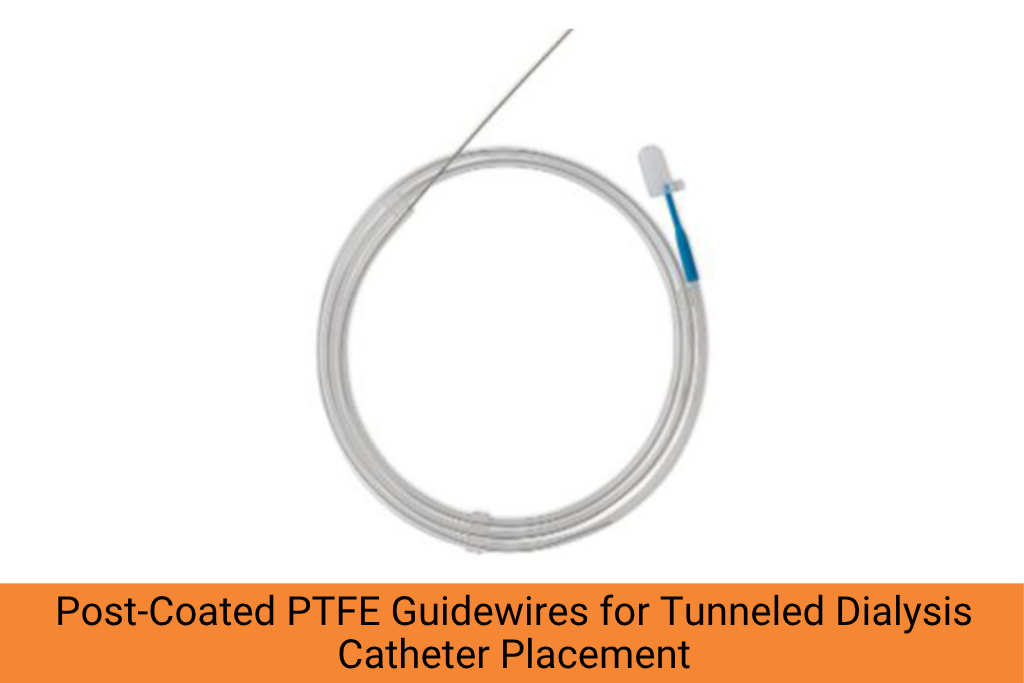
Tunneled hemodialysis catheters, used for long-term renal replacement therapy, require guidewires that can sustain consistent performance across the full insertion sequence. Post coated PTFE guidewires – where the coating is applied after the wire is formed – offer a uniform surface finish that supports smooth catheter exchange and repositioning. During tunneled catheter placements over the guidewire, particularly in the internal jugular approach, the wire must maintain positional stability inside the superior vena cava while the tunnel is being formed subcutaneously. Post coating ensures the outer surface retains adequate lubricity even under torsional stress during these extended procedural steps.
Arteriovenous (AV) fistulas and grafts are the preferred long-term vascular access routes for hemodialysis, but they frequently develop stenosis, thrombosis or aneurysmal changes requiring percutaneous intervention. Pre-coated PTFE guidewires – manufactured with the PTFE layer integrated before final wire processing – are used in these access salvage procedures to cross stenotic segments and facilitate balloon angioplasty. The wire is introduced through the fistula or graft lumen, advanced across the stenotic zone and used to deliver the balloon catheter to the target lesion. The pre-coating provides consistent low-friction performance from the outset, which is critical when navigating tortuous or heavily calcified access circuits in long-standing dialysis patients.
Our Other Product
Hydrophilic GuidewiresAngiography PTFE coated guidewires are specifically engineered for use in renal angiography and interventional procedures targeting the renal vasculature. In patients with renovascular hypertension, renal artery stenosis or transplant renal artery complications, these guidewires are advanced through the femoral or radial artery approach to selectively cannulate renal arteries for diagnostic imaging or stent placement. The angiography-grade PTFE coating allows the wire to move smoothly through arterial sheaths and guiding catheters while maintaining the torque fidelity necessary for selective catheterization. In nephrology-related interventional radiology, their use extends to renal vein sampling, renal tumor embolization and post-transplant vascular surveillance procedures.
Peritoneal dialysis (PD) catheter insertion, whether performed percutaneously or surgically, often involves a guidewire-assisted technique – particularly the modified Seldinger or trocar-guided approaches. A PTFE coated guidewire is used to guide the catheter tip into the pelvic peritoneal cavity, ensuring the distal end reaches the pouch of Douglas for optimal drainage. In the percutaneous approach, the wire traverses the abdominal wall and peritoneum through a needle track and the low surface friction of the PTFE wire minimizes tissue drag and reduces the procedural time required to advance the PD catheter over the wire into correct anatomical position.
For nephrology departments and dialysis centers sourcing these devices, working with a qualified PTFE coated guidewire manufacturer and supplier ensures procedural consistency and regulatory compliance. Wire specifications relevant to nephrology include available lengths, diameter compatibility with hemodialysis catheter introducers and tip configuration options – both straight and angled – to suit different venous access trajectories. A reliable PTFE coated guidewire supplier maintains validated coating processes, confirms ISO 13485 compliance and offers the full range including post coated, pre-coated and angiography-specific variants to meet procedural diversity in a nephrology and interventional setting.
St. Stone Medical Devices Pvt. Ltd., established in 2012 and operational since 2014, is a licensed manufacturer and exporter of medical devices based in India, holding certifications including ISO 13485:2016, CE and WHO-GMP. The company’s Shinewire™ range of guidewires includes post coated PTFE guidewires, pre-coated PTFE guidewires, hydrophilic coated guidewires, Nitinol core guidewires and angiography PTFE coated guidewires, catering to nephrology, interventional cardiology and cathlab applications. With distribution to over 20 countries across Africa, the Middle East and Asia, St. Stone Medical is a recognized PTFE coated guidewire manufacturer and supplier committed to quality-driven healthcare solutions.
Our Other Product
Zebra Guidewires Email Us Today!
PTFE coated guidewires serve a foundational role across the full spectrum of nephrology and hemodialysis access procedures – from central venous catheter insertion and tunneled dialysis line placement to AV fistula intervention and renal angiography. Their procedural versatility, supported by variant-specific engineering such as pre-coated and post coated constructions, makes them an indispensable device category in both acute and long-term renal care settings. Selecting the appropriate wire type and sourcing from a certified PTFE coated guidewire manufacturer directly influences procedural efficiency, patient safety and access longevity in any dialysis or interventional nephrology program.
We are recognized as one of the leading manufacturers, exporters, and suppliers of a diverse range of high-quality medical devices in India. Our products, including Interventional Cardiology, Nephrology, Anaesthesia, General Consumables, and Critical Care Accessories, are designed to meet the highest standards of excellence, ensuring reliable performance and patient care.
A – 8, Kuraopokpi industrial Estate,
Thoubal (kakching) Imphal,
Manipur – 795001, India.