Read Our Article
Long Term Hemodialysis Catheters: Bridging the Dialysis Access Gap in Sub-Saharan Africa
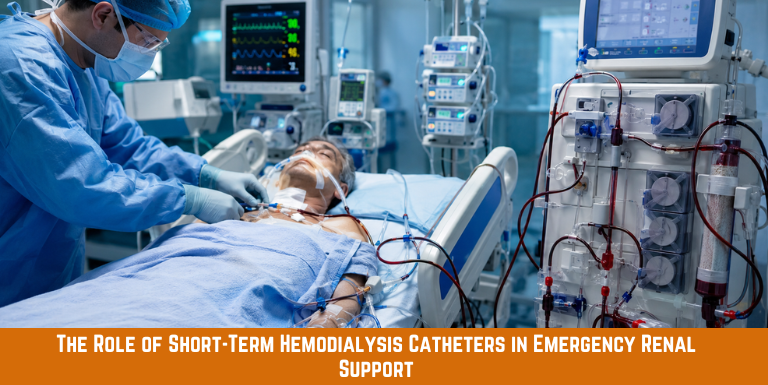
In critical care environments, time-sensitive decisions define patient outcomes. When acute kidney injury (AKI) strikes – whether from septic shock, trauma, post-surgical complications or multi-organ failure – clinicians need vascular access that can be established within minutes, not hours. This is exactly the clinical gap that a short term hemodialysis catheter addresses with unmatched reliability. Unlike permanent or tunneled access options that demand surgical planning and healing time, short-term catheters allow renal replacement therapy (RRT) to begin almost immediately after placement, making them the preferred first-line tool in intensive care units (ICUs) globally.
Short-term dialysis catheter placement is guided by the Seldinger technique, which allows percutaneous vascular access without surgical incisions. In a hemodynamically unstable patient, every hour of delayed dialysis can worsen metabolic acidosis, fluid overload and hyperkalemia. Because these catheters are designed for rapid bedside insertion – typically via the internal jugular, subclavian or femoral vein – intensivists and nephrologists can initiate continuous renal replacement therapy (CRRT) or intermittent hemodialysis (IHD) without waiting for surgical scheduling or specialized interventional suites. This immediacy is simply not achievable with arteriovenous fistulas or tunneled catheters, which require maturation periods or procedural planning.
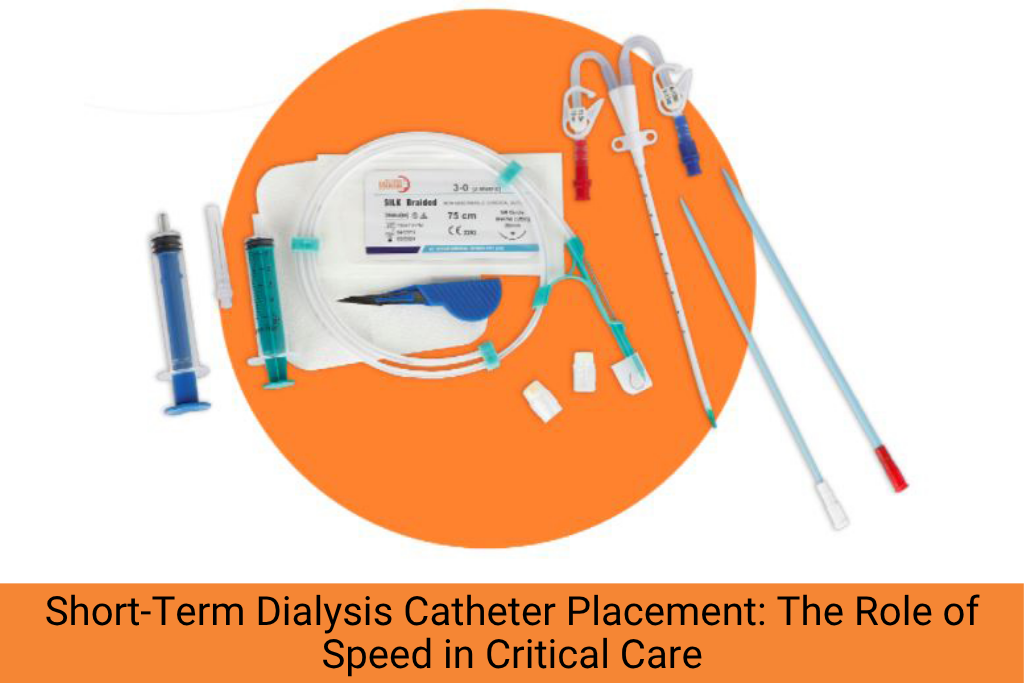
A well-engineered short-term dialysis catheter kit consolidates every procedural essential into a single sterile package, reducing preparation time and the risk of supply-chain errors during emergencies. A standard kit typically includes a polyurethane HD catheter in straight or curved configuration, a nitinol core guidewire with a J-tip advancer, vessel dilators of graduated sizing, an 18G introducer needle, a guiding syringe, disposable syringes, an injection cap, a scalpel, a drape sheet, a suture needle and a catheter protector pouch. The inclusion of a patient identification sticker further supports documentation standards in high-acuity settings. When all components are pre-assembled, sterilized and validated together, the clinical team can focus on the patient rather than equipment logistics – a factor that directly influences procedural safety in time-critical scenarios.
Short term hemodialysis catheters occupy a defined but irreplaceable position in the temporary vascular access hierarchy. Current KDIGO (Kidney Disease: Improving Global Outcomes) guidelines recommend non-tunneled dialysis catheters for patients who require urgent RRT initiation and are expected to recover renal function within days to weeks. This guidance reflects a key clinical principle: not every patient who needs dialysis in the ICU will need it permanently. Conditions such as contrast-induced nephropathy, rhabdomyolysis-associated AKI, drug toxicity requiring extracorporeal clearance or post-cardiac surgery renal impairment often resolve with supportive therapy. Placing a tunneled catheter or planning for fistula creation in these patients would expose them to unnecessary procedural risks. The short-term catheter, therefore, serves as the physiologically sound and guideline-aligned first response.
 Call Us Now!
One of the most practical considerations in short-term hemodialysis catheter selection is lumen configuration. Double lumen catheters remain the standard, with one lumen serving as arterial draw and the other as venous return, enabling continuous blood circuit circulation for effective solute and fluid removal. Triple lumen configurations offer an additional port for simultaneous medication infusion or central venous pressure monitoring – a significant advantage in critically ill patients who are already receiving multiple intravenous therapies.
Polyurethane is the dominant material of choice in short term dialysis catheter construction and this preference is not arbitrary. Polyurethane offers a favorable balance of rigidity during insertion and flexibility once in the bloodstream, minimizing endovascular trauma. Unlike older silicone-based devices, polyurethane catheters have narrower wall thickness for equivalent lumen size, which translates to higher blood flow rates at lower negative pressure – a clinically meaningful difference during CRRT where sustained flow rates of 150–250 mL/min are required. Additionally, polyurethane demonstrates lower thrombogenicity compared to PVC, which matters considerably in ICU patients who may already have coagulation abnormalities from underlying illness or anticoagulation therapy.
Our Other Product
Long Term Hemodialysis CathetersThe clinical application of a short term hemodialysis catheter kit is not limited to a single modality of RRT. In post-cardiac surgery ICUs or pediatric critical care, CRRT is often the modality of choice because it offers slower, more hemodynamically tolerable solute and fluid removal. In general nephrology wards or step-down units managing patients with stable hemodynamics, IHD delivers equivalent clearance in shorter session times. Both modalities rely on the same catheter infrastructure – a catheter with adequate luminal diameter and sufficient length calibrated to the access site. The versatility of a single short-term catheter design across multiple RRT protocols reinforces its utility as a standardized access solution for critical care nephrology teams.
Procurement decisions for vascular access devices in hospitals increasingly focus on manufacturer quality systems, not just unit price. A short term hemodialysis catheters manufacturer operating under ISO 13485:2016 quality management standards and holding WHO-GMP and CE certifications provides documented evidence of process control, sterility assurance and biocompatibility testing. In markets where counterfeit or substandard medical consumables represent a genuine patient safety concern, regulatory compliance by the manufacturer functions as a de facto quality guarantee. Hospitals and procurement teams sourcing from certified manufacturers also meet the audit requirements of accreditation bodies such as NABH and JCI, which increasingly scrutinize the quality pedigree of single-use vascular access devices.
Clinical protocols generally recommend reassessing short-term dialysis catheter necessity every 72 to 96 hours. Prolonged use beyond two weeks significantly elevates catheter-related bloodstream infection (CRBSI) risk – a complication carrying 20–25% attributable mortality in ICU populations according to published literature. This is why short-term catheter use is paired with a structured transition pathway: if a patient is not recovering renal function within the expected window, clinicians typically plan for tunneled catheter placement or initiate permanent vascular access workup. The short-term device, therefore, does not compete with long-term access strategies – it creates the bridge that buys time for informed, patient-specific decision-making.
St. Stone Medical Devices Pvt. Ltd. (stsmedicals.com) is an ISO 13485:2016, WHO-GMP and CE-certified medical device manufacturer established in 2012, operating from its manufacturing facility in Manipur and corporate office in New Delhi, India. As a licensed short term hemodialysis catheters manufacturer and supplier, the company specializes in nephrology devices, interventional cardiology consumables, critical care accessories and general disposables, distributing across approximately 20 countries spanning Asia, Africa and the Middle East. Their short term dialysis catheter kit range includes both double lumen and triple lumen configurations, designed and validated to meet the access demands of acute and critical care renal replacement therapy.
Our Other Product
Hemodialysis Compound Catheter KitShort-term hemodialysis catheters remain the clinical standard for initiating renal replacement therapy in critical care because they uniquely balance procedural speed, hemodynamic tolerability and clinical reversibility. From the structured contents of a short term dialysis catheter kit to the polyurethane construction that supports adequate blood flow rates, every design element is aligned with the realities of ICU nephrology. As acute kidney injury continues to rise among hospitalized patients globally, the role of a well-manufactured, guideline-supported short-term hemodialysis catheter kit in saving lives and bridging patients toward recovery cannot be overstated.
We are recognized as one of the leading manufacturers, exporters, and suppliers of a diverse range of high-quality medical devices in India. Our products, including Interventional Cardiology, Nephrology, Anaesthesia, General Consumables, and Critical Care Accessories, are designed to meet the highest standards of excellence, ensuring reliable performance and patient care.
A – 8, Kuraopokpi industrial Estate,
Thoubal (kakching) Imphal,
Manipur – 795001, India.