

A Y connector is a small but essential accessory used throughout interventional radiology, cardiology, and critical care to join two lines into a single access point without introducing air or losing hemostatic seal. Shaped like the letter Y, it allows a guidewire, catheter, or device to pass through the main channel while a side port remains available for flushing, contrast injection, or pressure monitoring.
Despite its simple appearance, the quality of a Y connector directly affects procedural safety, since a poor seal can allow blood loss or air entry at the access site during a procedure that already carries inherent risk.
A typical Y connector consists of a main body with two arms, one aligned with the guidewire or catheter pathway and the other set at an angle to accept a syringe, tubing, or monitoring line. Many designs include a rotating hemostatic valve, often called a Touhy Borst adapter, which can be tightened around a guidewire or catheter to prevent backbleeding while still allowing the device to move freely through the seal.
The main body is usually molded from clear medical grade polymer so the operator can visually confirm blood flashback and detect air bubbles before proceeding, an important safety check during introducer sheath placement and catheter exchange.
Several valve mechanisms are used across Y connector designs, each suited to slightly different procedural preferences. A push click design allows the operator to lock the valve around a device with a simple forward motion, useful when quick, repeated adjustments are needed during a procedure.
A push pull mechanism achieves a similar seal through a sliding collar that the operator compresses by hand, offering fine control over valve tightness. The Touhy Borst design uses a threaded cap that is manually rotated to compress an internal gasket, providing a very secure seal suited to procedures where the connector will remain in place for an extended period without frequent adjustment.
Y connectors appear throughout coronary and peripheral angiography, where they attach to the introducer sheath to allow guidewire passage while maintaining a flush line for heparinized saline. In neurointerventional procedures, they are used with microcatheters to control backbleeding during delicate access through smaller vessels.
They are also common in dialysis and long term vascular access, connecting catheter hubs to administration sets while allowing intermittent flushing without disconnecting the main line, which reduces the frequency of line manipulation and the associated infection risk.
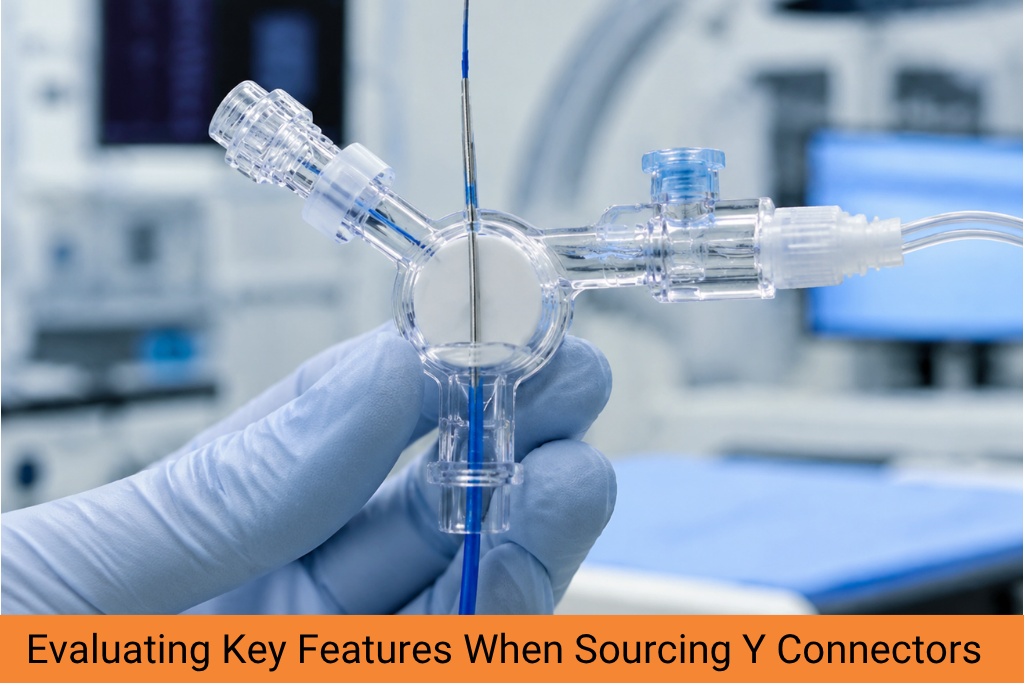
Hospitals and distributors evaluating Y connector suppliers should assess valve consistency across units, since a seal that is too loose risks blood loss while one that is too tight can damage the guidewire or catheter surface passing through it. Low priming volume reduces wasted contrast or saline, and a clear body supports visual confirmation of flow and flashback.
Luer lock side ports that comply with recognized small bore connector standards help ensure compatibility with a wide range of syringes and tubing sets already in use across a hospital’s procedure trays, reducing the risk of connection errors between incompatible components.
Because a Y connector sits directly in the fluid pathway between a patient and the procedure team, reuse or inadequate sterilization introduces a real risk of cross contamination between cases. Most hospitals now specify single use, individually packaged Y connectors, sterilized using ethylene oxide and validated according to internationally recognized sterility assurance levels.
This approach aligns with broader infection prevention guidance published by public health authorities, including the World Health Organization, which emphasizes minimizing the reuse of invasive components that come into direct or indirect contact with a patient’s bloodstream during interventional procedures.
Y connectors are typically manufactured to accommodate a defined range of guidewire and catheter diameters, and using a connector outside its intended range can compromise the hemostatic seal. Procedure teams should confirm compatibility with the specific guidewire gauge and catheter French size being used, particularly in neurointerventional and pediatric procedures where device dimensions are smaller and tolerances tighter.
Distributors supplying multiple specialties within the same hospital often stock several Y connector sizes to match the varied procedure mix across cardiology, radiology, and vascular surgery departments, rather than assuming a single universal size will suit every case.
Even a well made Y connector can create procedural friction if the wrong configuration is used for a given task. A valve that is tightened too aggressively around a guidewire can create excess friction, slowing wire advancement and making the operator work harder than necessary to cross a lesion. Conversely, a valve left too loose risks slow backbleeding that can go unnoticed if the operator’s attention is focused elsewhere on the field.
Training new staff to recognize the correct amount of resistance when adjusting a Touhy Borst cap, and to periodically check for backbleeding around the seal during longer procedures, reduces the chance that a connector issue is mistaken for a device or technique problem elsewhere in the case.
Many cathlabs and interventional radiology suites now build standardized procedure trays that bundle the Y connector with the introducer sheath, guidewire, and manifold typically used together for a given case type. This bundling approach reduces the time staff spend gathering individual components before a procedure and helps ensure that compatible, correctly sized parts are used together consistently.
Distributors that can supply a full matched set, rather than individual components sourced from different manufacturers, often become preferred vendors for hospitals looking to simplify their procurement relationships and reduce the administrative burden of managing multiple supplier contracts for what is functionally a single procedure kit.
Y connectors are manufactured under an ISO 13485 certified quality management system, with material biocompatibility and mechanical performance tested against internationally recognized standards for medical device connectors. CE marking applies for products entering the European market, while United States distribution generally follows the Food and Drug Administration’s premarket notification process.
Government hospitals and tender boards across many export markets request documentation of valve seal testing and sterilization validation as part of vendor registration, making this paperwork a practical differentiator between suppliers offering similar looking products.
 Call Us Now!
St Stone Medical Devices Pvt Ltd manufactures Y connectors alongside its broader range of introducer sheaths, guidewires, manifolds, and dialysis consumables, supplying hospitals and distributors across multiple export markets from an ISO 13485 and WHO GMP certified facility.
Hospitals and distributors looking for a reliable Y connector supplier with export documentation ready for tender submission and bulk order capability can contact St Stone Medical Devices for product specifications, sample requests, and pricing.
Because the company manufactures a wide range of compatible cathlab accessories under one roof, hospitals can source an entire procedure tray, from the introducer sheath through the manifold and Y connector, with confidence that every component has been tested to work together as intended.
A Y connector is a small device with an outsized role in procedural safety, controlling backbleeding, maintaining flush access, and supporting smooth guidewire and catheter passage throughout interventional and critical care procedures. Buyers evaluating suppliers should look closely at valve mechanism consistency, priming volume, and documented quality certification rather than treating the device as an interchangeable commodity.
For hospitals and distributors seeking a dependable Y connector manufacturer, St Stone Medical Devices offers a certified, export ready range built for the demands of modern interventional practice, backed by consistent batch quality and complete documentation for tender submission.
We are recognized as one of the leading manufacturers, exporters, and suppliers of a diverse range of high-quality medical devices in India. Our products, including Interventional Cardiology, Nephrology, Anaesthesia, General Consumables, and Critical Care Accessories, are designed to meet the highest standards of excellence, ensuring reliable performance and patient care.
A – 8, Kuraopokpi industrial Estate,
Thoubal (kakching) Imphal,
Manipur – 795001, India.